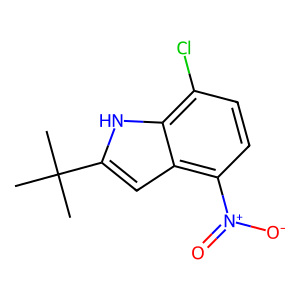
2-tert-Butyl-7-chloro-4-nitroindole
Names and Identifiers of 2-tert-Butyl-7-chloro-4-nitroindole
CAS Number |
1000018-53-0 |
|---|---|
MDL Number |
MFCD09743738 |
IUPAC Name |
2-tert-butyl-7-chloro-4-nitro-1H-indole |
InChI |
InChI=1S/C12H13ClN2O2/c1-12(2,3)10-6-7-9(15(16)17)5-4-8(13)11(7)14-10/h4-6,14H,1-3H3 |
InChIKey |
BOYFOMFZAHOXTC-UHFFFAOYSA-N |
Canonical SMILES |
CC(C)(C)C1=CC2=C(C=CC(=C2N1)Cl)[N+](=O)[O-] |
UNSPSC Code |
12352100 |
Physical and chemical properties of 2-tert-Butyl-7-chloro-4-nitroindole
Boiling Point |
404.4±40.0 °C at 760 mmHg |
|---|---|
Density |
1.3±0.1 g/cm3 |
Exact Mass |
252.066559 |
Flash Point |
198.3±27.3 °C |
Index of Refraction |
1.629 |
LogP |
4.72 |
Molecular Formula |
C12H13ClN2O2 |
Molecular Weight |
252.697 |
Vapour Pressure |
0.0±0.9 mmHg at 25°C |
Safety Information of 2-tert-Butyl-7-chloro-4-nitroindole

Applications of 2-tert-Butyl-7-chloro-4-nitroindole
The applications of 2-tert-butyl-7-chloro-4-nitroindole span several fields:
- Pharmaceutical Research: Its unique structure makes it valuable for drug development, particularly in targeting specific enzymes or receptors.
- Chemical Biology: It serves as a biochemical tool in proteomics and other biological assays due to its ability to interact with biomolecules.
Interaction Studies of 2-tert-Butyl-7-chloro-4-nitroindole
Interaction studies involving 2-tert-butyl-7-chloro-4-nitroindole focus on its binding affinity and selectivity towards various biological targets. These studies often utilize techniques such as:
- Molecular Docking: To predict how the compound interacts with specific proteins or enzymes.
- In vitro Assays: To evaluate its biological activity against different cell lines or enzymatic pathways.
Such studies are crucial for understanding its potential therapeutic applications.
Biological Activity of 2-tert-Butyl-7-chloro-4-nitroindole
2-tert-butyl-7-chloro-4-nitroindole has shown potential biological activities, particularly in proteomics research. Its structural modifications enhance its interactions with biological targets, making it a candidate for further pharmacological studies. The compound's ability to modulate biological pathways may be linked to its influence on enzymes or receptors involved in various cellular processes.