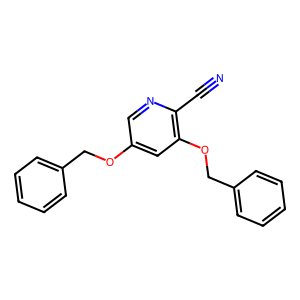
3,5-Bis(benzyloxy)picolinonitrile
Names and Identifiers of 3,5-Bis(benzyloxy)picolinonitrile
CAS Number |
1000025-92-2 |
|---|---|
IUPAC Name |
3,5-bis(phenylmethoxy)pyridine-2-carbonitrile |
InChI |
InChI=1S/C20H16N2O2/c21-12-19-20(24-15-17-9-5-2-6-10-17)11-18(13-22-19)23-14-16-7-3-1-4-8-16/h1-11,13H,14-15H2 |
InChIKey |
QBEIDMMMZMELLF-UHFFFAOYSA-N |
Canonical SMILES |
C1=CC=C(C=C1)COC2=CC(=C(N=C2)C#N)OCC3=CC=CC=C3 |
Physical and chemical properties of 3,5-Bis(benzyloxy)picolinonitrile
Acidity coefficient |
-5.06±0.10(Predicted) |
|---|---|
Boiling Point |
535.4±45.0 °C(Predicted) |
Density |
1.23 |
Exact Mass |
316.12100 |
LogP |
4.11128 |
Molecular Formula |
C20H16N2O2 |
Molecular Weight |
316.35300 |
PSA |
55.14000 |
Applications of 3,5-Bis(benzyloxy)picolinonitrile
3,5-Bis(benzyloxy)picolinonitrile has diverse applications, including:
- Pharmaceutical Development: Its potential as a drug candidate for treating various diseases due to its biological activity.
- Organic Synthesis: Used as an intermediate in the synthesis of more complex organic molecules.
- Material Science: Investigated for its properties in developing new materials with specific functionalities.
Interaction Studies of 3,5-Bis(benzyloxy)picolinonitrile
Interaction studies have focused on understanding how 3,5-Bis(benzyloxy)picolinonitrile interacts with biological macromolecules such as proteins and nucleic acids. These studies are crucial for elucidating its mechanism of action and potential therapeutic effects. Preliminary findings suggest that it may bind to specific targets involved in cellular signaling pathways, which could lead to its application in targeted therapies.
Biological Activity of 3,5-Bis(benzyloxy)picolinonitrile
Studies indicate that 3,5-Bis(benzyloxy)picolinonitrile exhibits significant biological activity, particularly in the realm of pharmacology. Its structural features suggest potential interactions with biological targets, making it a candidate for further investigation as a therapeutic agent. Research has shown that derivatives of picolinonitriles often possess anti-cancer properties and may act as enzyme inhibitors.
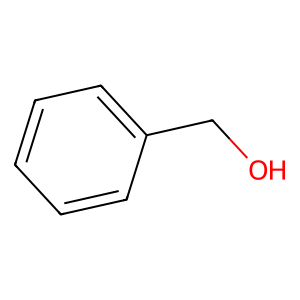 Cas:100-51-6

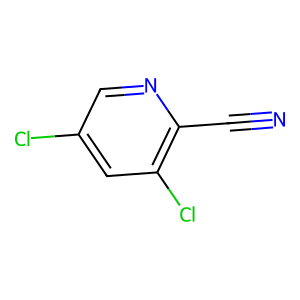 Cas:85331-33-5
