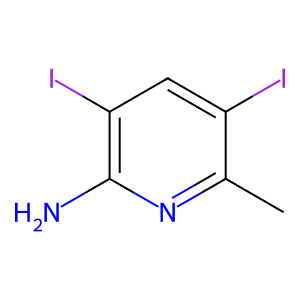
3,5-Diiodo-6-methylpyridin-2-amine
Names and Identifiers of 3,5-Diiodo-6-methylpyridin-2-amine
CAS Number |
1000342-88-0 |
|---|---|
EC Number |
680-945-9 |
MDL Number |
MFCD09880040 |
IUPAC Name |
3,5-diiodo-6-methylpyridin-2-amine |
InChI |
InChI=1S/C6H6I2N2/c1-3-4(7)2-5(8)6(9)10-3/h2H,1H3,(H2,9,10) |
InChIKey |
BSXUGYBTSPNQDE-UHFFFAOYSA-N |
Canonical SMILES |
CC1=NC(=C(C=C1I)I)N |
UNSPSC Code |
12352100 |
Physical and chemical properties of 3,5-Diiodo-6-methylpyridin-2-amine
Exact Mass |
359.86200 |
|---|---|
LogP |
2.76260 |
Molecular Formula |
C6H6I2N2 |
Molecular Weight |
359.93400 |
PSA |
38.91000 |
Storage condition |
2-8°C |
Safety Information of 3,5-Diiodo-6-methylpyridin-2-amine

Applications of 3,5-Diiodo-6-methylpyridin-2-amine
3,5-Diiodo-6-methylpyridin-2-amine has several applications:
- Chemistry: Used as a building block for synthesizing more complex pyridine derivatives.
- Biology: Explored for its potential biological activities, including antimicrobial and anticancer properties.
- Medicine: Investigated as a precursor for drug development due to its structural features.
- Industry: Utilized in developing materials with specific electronic properties.
Interaction Studies of 3,5-Diiodo-6-methylpyridin-2-amine
The interactions of 3,5-Diiodo-6-methylpyridin-2-amine with biological targets are crucial for understanding its potential therapeutic effects. Studies suggest that the compound can form stable complexes with enzymes and receptors through halogen bonding facilitated by the iodine atoms. These interactions may enhance the specificity and efficacy of the compound in biological systems, leading to various pharmacological outcomes.
Biological Activity of 3,5-Diiodo-6-methylpyridin-2-amine
Research indicates that 3,5-Diiodo-6-methylpyridin-2-amine may possess significant biological activities. It has been investigated for potential antimicrobial and anticancer properties. The mechanism of action is thought to involve interactions with various molecular targets, such as enzymes and receptors, where the iodine atoms enhance binding affinity through halogen bonding. This characteristic may lead to modulation of biological pathways, thereby exerting therapeutic effects.