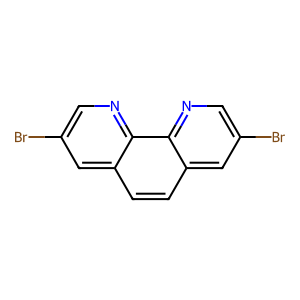
3,8-Dibromo-1,10-phenanthroline
Names and Identifiers of 3,8-Dibromo-1,10-phenanthroline
CAS Number |
100125-12-0 |
|---|---|
EC Number |
845-981-3 |
MDL Number |
MFCD09909860 |
IUPAC Name |
3,8-dibromo-1,10-phenanthroline |
InChI |
InChI=1S/C12H6Br2N2/c13-9-3-7-1-2-8-4-10(14)6-16-12(8)11(7)15-5-9/h1-6H |
InChIKey |
IDWJREBUVYSPKS-UHFFFAOYSA-N |
Canonical SMILES |
C1=CC2=CC(=CN=C2C3=NC=C(C=C31)Br)Br |
UNSPSC Code |
12352100 |
Physical and chemical properties of 3,8-Dibromo-1,10-phenanthroline
Acidity coefficient |
3.90±0.10(Predicted) |
|---|---|
Boiling Point |
428.9±40.0 °C at 760 mmHg |
Density |
1.9±0.1 g/cm3 |
Exact Mass |
335.889771 |
Flash Point |
213.2±27.3 °C |
Index of Refraction |
1.772 |
LogP |
3.67 |
Melting Point |
282 °C |
Molecular Formula |
C12H6Br2N2 |
Molecular Weight |
337.997 |
PSA |
25.78000 |
Storage condition |
Sealed in dry,Room Temperature |
Vapour Pressure |
0.0±1.0 mmHg at 25°C |
λmax |
352nm(DMF)(lit.) |
Safety Information of 3,8-Dibromo-1,10-phenanthroline


Applications of 3,8-Dibromo-1,10-phenanthroline
3,8-Dibromo-1,10-phenanthroline finds applications in various fields:
- Coordination Chemistry: It is used as a ligand in coordination complexes due to its ability to coordinate with transition metals.
- Material Science: The compound can be utilized in the synthesis of organic semiconductors and other advanced materials.
- Biological Research: Its potential anticancer properties make it a candidate for further research in drug development.
Interaction Studies of 3,8-Dibromo-1,10-phenanthroline
Interaction studies involving 3,8-dibromo-1,10-phenanthroline have focused on its ability to form complexes with various metal ions. These studies reveal that the compound can stabilize metal ions through chelation, which may enhance their biological activity or alter their electronic properties. The interactions with metals like copper and palladium have been particularly noted for their significance in catalysis and material synthesis.
Biological Activity of 3,8-Dibromo-1,10-phenanthroline
The biological activity of 3,8-dibromo-1,10-phenanthroline has been explored primarily in the context of its potential as an anticancer agent. Studies indicate that it may exhibit cytotoxic properties against various cancer cell lines. Additionally, its ability to form complexes with metal ions may enhance its biological efficacy by facilitating targeted delivery or enhancing interaction with biological targets.
Physical sample testing spectrum (NMR) of 3,8-Dibromo-1,10-phenanthroline

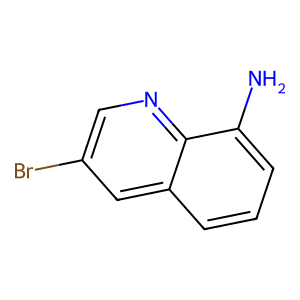 Cas:139399-67-0

 Cas:408529-03-3

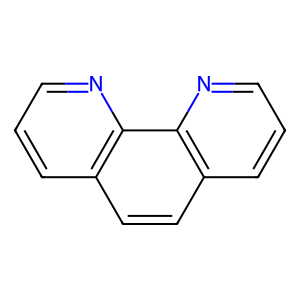 Cas:66-71-7
 Cas:3829-86-5