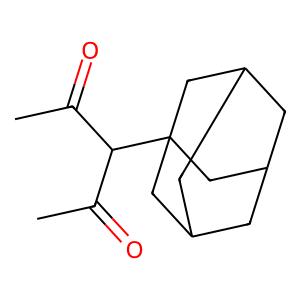
3-(1-Adamantyl)-2,4-pentanedione
Names and Identifiers of 3-(1-Adamantyl)-2,4-pentanedione
CAS Number |
102402-84-6 |
|---|---|
IUPAC Name |
3-(1-adamantyl)pentane-2,4-dione |
InChI |
InChI=1S/C15H22O2/c1-9(16)14(10(2)17)15-6-11-3-12(7-15)5-13(4-11)8-15/h11-14H,3-8H2,1-2H3 |
InChIKey |
QYCOSPWVQKZONV-UHFFFAOYSA-N |
Canonical SMILES |
CC(=O)C(C(=O)C)C12CC3CC(C1)CC(C3)C2 |
Physical and chemical properties of 3-(1-Adamantyl)-2,4-pentanedione
Boiling Point |
335.9ºC at 760 mmHg |
|---|---|
Density |
1.097g/cm3 |
Exact Mass |
234.16200 |
Flash Point |
126ºC |
Index of Refraction |
1.523 |
LogP |
2.99700 |
Melting Point |
55-56℃ |
Molecular Formula |
C15H22O2 |
Molecular Weight |
234.33400 |
PSA |
34.14000 |
Vapour Pressure |
0.000116mmHg at 25°C |
Applications of 3-(1-Adamantyl)-2,4-pentanedione
3-(1-Adamantyl)-2,4-pentanedione finds applications in various fields:
- Pharmaceutical Development: Its unique structure may contribute to the development of new pharmaceuticals, particularly in creating compounds with enhanced biological activity.
- Chemical Synthesis: It serves as an intermediate in organic synthesis, allowing for the preparation of more complex molecules.
- Material Science: Its properties may be exploited in developing new materials with specific characteristics, such as polymers or coatings.
Interaction Studies of 3-(1-Adamantyl)-2,4-pentanedione
Studies on the interactions of 3-(1-Adamantyl)-2,4-pentanedione with biological targets have indicated that it may interact with enzymes or receptors due to its structural features. These interactions could lead to significant biological effects, making it a subject of interest for further research in medicinal chemistry and pharmacology. Investigations into its binding affinities and mechanisms of action are ongoing to elucidate its potential therapeutic roles.
Biological Activity of 3-(1-Adamantyl)-2,4-pentanedione
The biological activity of 3-(1-Adamantyl)-2,4-pentanedione has been explored in various studies. Preliminary investigations suggest that it may exhibit antimicrobial properties and could be a potential candidate for drug development. The adamantyl moiety is known for enhancing the lipophilicity of compounds, which can improve their bioavailability and efficacy in biological systems.
 Cas:123-54-6

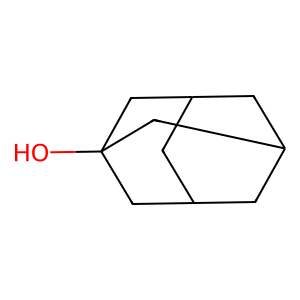 Cas:768-95-6

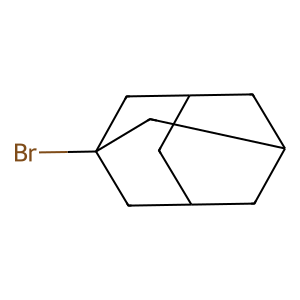 Cas:768-90-1
 Cas:32314-61-7