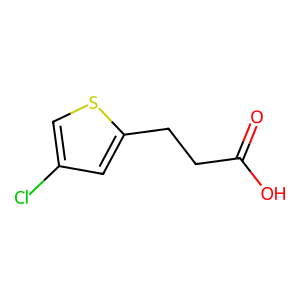
3-(4-Chlorothiophen-2-yl)propanoic acid
Names and Identifiers of 3-(4-Chlorothiophen-2-yl)propanoic acid
CAS Number |
89793-51-1 |
|---|---|
MDL Number |
MFCD18324747 |
IUPAC Name |
3-(4-chlorothiophen-2-yl)propanoic acid |
InChI |
InChI=1S/C7H7ClO2S/c8-5-3-6(11-4-5)1-2-7(9)10/h3-4H,1-2H2,(H,9,10) |
InChIKey |
AGGRDDNHSGUWGK-UHFFFAOYSA-N |
Canonical SMILES |
C1=C(SC=C1Cl)CCC(=O)O |
UNSPSC Code |
12352100 |
Physical and chemical properties of 3-(4-Chlorothiophen-2-yl)propanoic acid
H Bond Acceptors |
2 |
|---|---|
H Bond Donors |
1 |
LogP |
2.57248881966667 |
Molecular Formula |
C7H7ClO2S |
Molecular Weight |
190.65 |
Safety Information of 3-(4-Chlorothiophen-2-yl)propanoic acid

Applications of 3-(4-Chlorothiophen-2-yl)propanoic acid
3-(4-Chlorothiophen-2-yl)propanoic acid has diverse applications:
- Organic Synthesis: It serves as a building block for synthesizing more complex organic molecules.
- Biological Research: Used in studies related to enzyme inhibition and protein interactions.
- Material Science: Potential applications in developing new materials with specific electronic or optical properties.
Interaction Studies of 3-(4-Chlorothiophen-2-yl)propanoic acid
Research indicates that 3-(4-Chlorothiophen-2-yl)propanoic acid interacts with various biological targets, which may include enzymes and receptors involved in metabolic pathways. These interactions can lead to inhibition or modulation of specific biological processes, making it valuable in pharmacological studies. Further investigation into its binding affinities and mechanisms is essential for understanding its full potential.
Biological Activity of 3-(4-Chlorothiophen-2-yl)propanoic acid
3-(4-Chlorothiophen-2-yl)propanoic acid exhibits notable biological activity. It has been investigated for its potential role in enzyme inhibition and as a probe for biological assays. The specific mechanism of action often involves interaction with enzymes or receptors, leading to modulation of biochemical pathways. Its unique structure may contribute to its effectiveness in these roles.