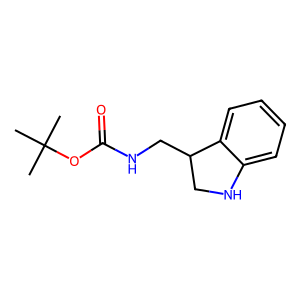
3-(Boc-aminomethyl)indoline
CAS No.:
1000932-73-9
M. Wt:
248.321
M. Fa:
C14H20N2O2
InChI Key:
ZYDGETNTBBDROM-UHFFFAOYSA-N
Appearance:
Solid
Names and Identifiers of 3-(Boc-aminomethyl)indoline
CAS Number |
1000932-73-9 |
|---|---|
MDL Number |
MFCD09971405 |
IUPAC Name |
tert-butyl N-(2,3-dihydro-1H-indol-3-ylmethyl)carbamate |
InChI |
InChI=1S/C14H20N2O2/c1-14(2,3)18-13(17)16-9-10-8-15-12-7-5-4-6-11(10)12/h4-7,10,15H,8-9H2,1-3H3,(H,16,17) |
InChIKey |
ZYDGETNTBBDROM-UHFFFAOYSA-N |
Canonical SMILES |
CC(C)(C)OC(=O)NCC1CNC2=CC=CC=C12 |
UNSPSC Code |
12352100 |
Physical and chemical properties of 3-(Boc-aminomethyl)indoline
Acidity coefficient |
12.35±0.46(Predicted) |
|---|---|
Boiling Point |
382.6±21.0 °C at 760 mmHg |
Density |
1.1±0.1 g/cm3 |
Exact Mass |
248.152481 |
Flash Point |
185.2±22.1 °C |
Index of Refraction |
1.522 |
LogP |
2.29 |
Molecular Formula |
C14H20N2O2 |
Molecular Weight |
248.321 |
Vapour Pressure |
0.0±0.9 mmHg at 25°C |
Safety Information of 3-(Boc-aminomethyl)indoline

Applications of 3-(Boc-aminomethyl)indoline
3-(Boc-aminomethyl)indoline finds applications in various fields:
- Pharmaceutical Development: Its derivatives are explored as potential drugs due to their biological activities.
- Organic Synthesis: The compound serves as an intermediate in synthesizing more complex molecules, including natural products and pharmaceuticals.
- Material Science: Indoline derivatives may have applications in developing new materials with unique electronic properties.
Interaction Studies of 3-(Boc-aminomethyl)indoline
Studies on 3-(Boc-aminomethyl)indoline often focus on its interactions with biological targets. These include:
- Enzyme Inhibition: Investigations into how the compound inhibits specific enzymes involved in disease pathways.
- Receptor Binding Studies: Research assessing how well the compound binds to various receptors, contributing to its pharmacological profile.
- Molecular Docking Studies: Computational models are used to predict binding affinities and interactions with target proteins.
Biological Activity of 3-(Boc-aminomethyl)indoline
3-(Boc-aminomethyl)indoline and its derivatives have been studied for their potential biological activities, particularly as:
- Anticancer Agents: Some studies indicate that indoline derivatives exhibit cytotoxic effects against various cancer cell lines.
- Antimicrobial Compounds: The compound has shown promise in inhibiting bacterial growth, making it a candidate for developing new antibiotics.
- Neuroprotective Agents: Research suggests potential neuroprotective effects, indicating possible applications in treating neurodegenerative diseases.
Physical sample testing spectrum (NMR) of 3-(Boc-aminomethyl)indoline
