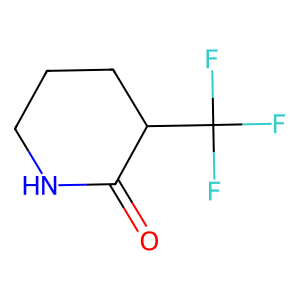
3-(TRIFLUOROMETHYL)PIPERIDIN-2-ONE
CAS No.:
1000934-03-1
M. Wt:
167.13
M. Fa:
C6H8F3NO
InChI Key:
WDEBTTOBFKEZBC-UHFFFAOYSA-N
Appearance:
White To Off-White Solid
Names and Identifiers of 3-(TRIFLUOROMETHYL)PIPERIDIN-2-ONE
CAS Number |
1000934-03-1 |
|---|---|
MDL Number |
MFCD09802218 |
IUPAC Name |
3-(trifluoromethyl)piperidin-2-one |
InChI |
InChI=1S/C6H8F3NO/c7-6(8,9)4-2-1-3-10-5(4)11/h4H,1-3H2,(H,10,11) |
InChIKey |
WDEBTTOBFKEZBC-UHFFFAOYSA-N |
Canonical SMILES |
O=C1NCCCC1C(F)(F)F |
UNSPSC Code |
12352100 |
Physical and chemical properties of 3-(TRIFLUOROMETHYL)PIPERIDIN-2-ONE
Acidity coefficient |
15.18±0.40(Predicted) |
|---|---|
Boiling Point |
237.6±35.0 °C(Predicted) |
Density |
1.265±0.06 g/cm3(Predicted) |
Exact Mass |
167.055801 |
Flash Point |
97.5±25.9 °C |
H Bond Acceptors |
1 |
H Bond Donors |
1 |
Index of Refraction |
1.390 |
LogP |
-0.40 |
Molecular Formula |
C6H8F3NO |
Molecular Weight |
167.13 |
Storage condition |
Sealed in dry,2-8°C |
Vapour Pressure |
0.0±0.5 mmHg at 25°C |
Safety Information of 3-(TRIFLUOROMETHYL)PIPERIDIN-2-ONE

Applications of 3-(TRIFLUOROMETHYL)PIPERIDIN-2-ONE
The unique properties of 3-(trifluoromethyl)piperidin-2-one make it valuable in several fields:
- Pharmaceutical Development: It serves as a key building block in the synthesis of novel drugs, particularly those targeting metabolic disorders and viral infections.
- Material Science: The incorporation of trifluoromethyl groups in polymers can enhance thermal stability and chemical resistance.
- Agricultural Chemistry: Its derivatives may also find applications as agrochemicals due to their potential bioactivity against pests or pathogens.
Interaction Studies of 3-(TRIFLUOROMETHYL)PIPERIDIN-2-ONE
Interaction studies involving 3-(trifluoromethyl)piperidin-2-one have focused on its binding affinities with various biological targets. For example:
- Molecular Docking Studies: These studies have demonstrated that certain derivatives exhibit favorable binding scores with specific receptors, suggesting potential therapeutic efficacy.
- Hydrogen Bonding Interactions: The trifluoromethyl group can participate in hydrogen bonding, which may enhance the stability and selectivity of interactions with target proteins.
Such studies are crucial for understanding how structural modifications can influence biological activity.
Biological Activity of 3-(TRIFLUOROMETHYL)PIPERIDIN-2-ONE
Research indicates that 3-(trifluoromethyl)piperidin-2-one derivatives exhibit significant biological activities. For instance:
- Antiviral Activity: Certain derivatives have shown promising antiviral properties, particularly against specific viral targets.
- Inhibition of Enzymes: The compound has been studied for its potential as an inhibitor of dipeptidyl peptidase IV, which is relevant in the treatment of type 2 diabetes.
- Neuropharmacological Effects: Some studies suggest that compounds containing this structure may influence neurotransmitter systems, indicating potential applications in treating neurological disorders.
Physical sample testing spectrum (NMR) of 3-(TRIFLUOROMETHYL)PIPERIDIN-2-ONE
