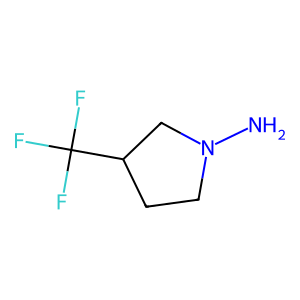
3-(Trifluoromethyl)pyrrolidin-1-amine
Names and Identifiers of 3-(Trifluoromethyl)pyrrolidin-1-amine
CAS Number |
935260-36-9 |
|---|---|
IUPAC Name |
3-(trifluoromethyl)pyrrolidin-1-amine |
InChI |
InChI=1S/C5H9F3N2/c6-5(7,8)4-1-2-10(9)3-4/h4H,1-3,9H2 |
InChIKey |
MECUILUVZMNAPO-UHFFFAOYSA-N |
Canonical SMILES |
C1CN(CC1C(F)(F)F)N |
Physical and chemical properties of 3-(Trifluoromethyl)pyrrolidin-1-amine
Molecular Formula |
C5H9F3N2 |
|---|---|
Molecular Weight |
154.13 |
Safety Information of 3-(Trifluoromethyl)pyrrolidin-1-amine

Applications of 3-(Trifluoromethyl)pyrrolidin-1-amine
3-(Trifluoromethyl)pyrrolidin-1-amine has several notable applications:
- Pharmaceutical Development: Its unique properties make it an attractive candidate for drug design, particularly in creating compounds that target specific biological pathways.
- Chemical Research: Used as a building block in organic synthesis, enabling the development of more complex molecules.
- Material Science: Potential applications in developing new materials with specific electronic or optical properties due to its unique chemical structure.
Interaction Studies of 3-(Trifluoromethyl)pyrrolidin-1-amine
Interaction studies involving 3-(trifluoromethyl)pyrrolidin-1-amine focus on its binding affinity to various biological targets. These studies often utilize techniques such as:
- Molecular Docking: To predict how well the compound binds to specific proteins or enzymes.
- In Vitro Assays: To evaluate the biological activity and mechanism of action by observing effects on cell lines or isolated biological systems.
Such studies help elucidate its potential therapeutic roles and guide further modifications to enhance efficacy.
Biological Activity of 3-(Trifluoromethyl)pyrrolidin-1-amine
Research has indicated that compounds containing trifluoromethyl groups exhibit unique biological activities. 3-(Trifluoromethyl)pyrrolidin-1-amine has been studied for its potential in medicinal chemistry, particularly in the development of pharmaceuticals targeting various biological pathways. Its structure allows it to mimic certain biological molecules, potentially leading to interactions with receptors or enzymes involved in disease processes.
Studies have highlighted the potential of trifluoromethylated amines in enhancing the pharmacokinetic properties of drug candidates, making them more effective in therapeutic applications.