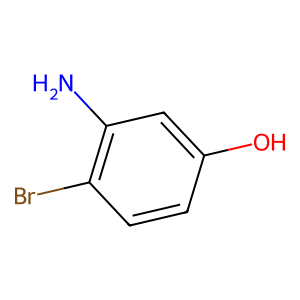
3-Amino-4-bromophenol
CAS No.:
100367-37-1
M. Wt:
188.022
M. Fa:
C6H6BrNO
InChI Key:
JJNOHJJIVAVDLP-UHFFFAOYSA-N
Appearance:
Off-white to light brown Solid
Names and Identifiers of 3-Amino-4-bromophenol
CAS Number |
100367-37-1 |
|---|---|
EC Number |
692-181-3 |
MDL Number |
MFCD09260886 |
IUPAC Name |
3-amino-4-bromophenol |
InChI |
InChI=1S/C6H6BrNO/c7-5-2-1-4(9)3-6(5)8/h1-3,9H,8H2 |
InChIKey |
JJNOHJJIVAVDLP-UHFFFAOYSA-N |
Canonical SMILES |
C1=CC(=C(C=C1O)N)Br |
UNSPSC Code |
12352100 |
Physical and chemical properties of 3-Amino-4-bromophenol
Acidity coefficient |
9.45±0.18(Predicted) |
|---|---|
Boiling Point |
300.1±22.0 °C at 760 mmHg |
Density |
1.8±0.1 g/cm3 |
Exact Mass |
186.963272 |
Flash Point |
135.3±22.3 °C |
Index of Refraction |
1.677 |
LogP |
1.83 |
Molecular Formula |
C6H6BrNO |
Molecular Weight |
188.022 |
PSA |
46.25000 |
Storage condition |
2-8°C |
Vapour Pressure |
0.0±0.7 mmHg at 25°C |
Safety Information of 3-Amino-4-bromophenol

Applications of 3-Amino-4-bromophenol
3-Amino-4-bromophenol has several applications across different fields:
- Dyes and Pigments: It is used as an intermediate in the synthesis of dyes and pigments due to its reactive functional groups.
- Pharmaceuticals: Its derivatives are explored for developing new drugs with antimicrobial or antioxidant properties.
- Chemical Research: The compound serves as a reagent in various organic synthesis processes.
Interaction Studies of 3-Amino-4-bromophenol
Studies on the interactions of 3-amino-4-bromophenol with biological systems have shown:
- Binding Affinity: Research indicates that it may interact with specific enzymes or receptors, potentially influencing metabolic pathways.
- Toxicological Assessments: Evaluations of its safety profile are essential, particularly regarding its effects on human health and the environment.
These studies are crucial for understanding how this compound can be safely utilized in various applications.
Biological Activity of 3-Amino-4-bromophenol
3-Amino-4-bromophenol exhibits notable biological activity. It has been studied for its potential as:
- Antimicrobial Agent: Some studies suggest that bromophenols possess antimicrobial properties, which could be attributed to their ability to disrupt microbial cell membranes.
- Antioxidant Activity: The compound may also function as an antioxidant, scavenging free radicals and protecting cells from oxidative stress.
- Pharmacological
Physical sample testing spectrum (NMR) of 3-Amino-4-bromophenol

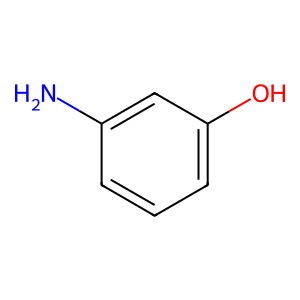 Cas:591-27-5
