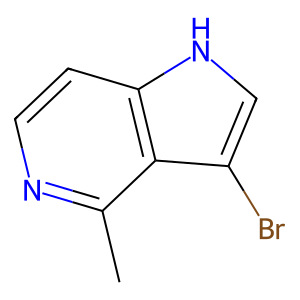
3-BROMO-4-METHYL-5-AZAINDOLE
Names and Identifiers of 3-BROMO-4-METHYL-5-AZAINDOLE
CAS Number |
1000342-72-2 |
|---|---|
MDL Number |
MFCD09749964 |
IUPAC Name |
3-bromo-4-methyl-1H-pyrrolo[3,2-c]pyridine |
InChI |
InChI=1S/C8H7BrN2/c1-5-8-6(9)4-11-7(8)2-3-10-5/h2-4,11H,1H3 |
InChIKey |
UBMRHTWKYONRMN-UHFFFAOYSA-N |
Canonical SMILES |
CC1=NC=CC2=C1C(Br)=CN2 |
UNSPSC Code |
12352100 |
Physical and chemical properties of 3-BROMO-4-METHYL-5-AZAINDOLE
Boiling Point |
347.2±37.0 °C at 760 mmHg |
|---|---|
Density |
1.7±0.1 g/cm3 |
Exact Mass |
209.979248 |
Flash Point |
163.8±26.5 °C |
H Bond Acceptors |
1 |
H Bond Donors |
1 |
Index of Refraction |
1.697 |
LogP |
1.88 |
Molecular Formula |
C8H7BrN2 |
Molecular Weight |
211.059 |
PSA |
28.68000 |
Storage condition |
2-8°C |
Vapour Pressure |
0.0±0.7 mmHg at 25°C |
Safety Information of 3-BROMO-4-METHYL-5-AZAINDOLE

Applications of 3-BROMO-4-METHYL-5-AZAINDOLE
3-Bromo-4-methyl-1H-pyrrolo[3,2-c]pyridine has numerous applications in scientific research:
- Medicinal Chemistry: It serves as a building block for synthesizing more complex heterocyclic compounds with potential therapeutic effects.
- Biological Studies: It is used in studies related to enzyme inhibitors and receptor modulators.
- Agrochemicals: The compound is also utilized in the synthesis of agrochemicals and specialty chemicals due to its unique structural properties.
Interaction Studies of 3-BROMO-4-METHYL-5-AZAINDOLE
Interaction studies involving 3-Bromo-4-methyl-1H-pyrrolo[3,2-c]pyridine have focused on its binding affinity to various proteins and receptors. For instance, structure-based design approaches have been employed to optimize its interactions with fibroblast growth factor receptors, enhancing its efficacy as a therapeutic agent. These studies are crucial for understanding the molecular mechanisms underlying its biological activity and potential therapeutic applications.
Biological Activity of 3-BROMO-4-METHYL-5-AZAINDOLE
Research indicates that 3-Bromo-4-methyl-1H-pyrrolo[3,2-c]pyridine exhibits significant biological activity, particularly in the realm of cancer research. It has been shown to inhibit the proliferation of cancer cells by targeting specific signaling pathways, including the RAS-MEK-ERK and PI3K-Akt pathways. This compound interacts with various biological targets, including fibroblast growth factor receptors (FGFRs), which are critical for cell signaling and growth regulation.