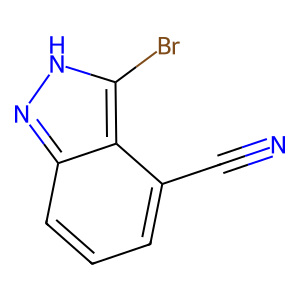
3-Bromo-1H-indazole-4-carbonitrile
Names and Identifiers of 3-Bromo-1H-indazole-4-carbonitrile
CAS Number |
1000341-36-5 |
|---|---|
MDL Number |
MFCD09263234 |
IUPAC Name |
3-bromo-2H-indazole-4-carbonitrile |
InChI |
InChI=1S/C8H4BrN3/c9-8-7-5(4-10)2-1-3-6(7)11-12-8/h1-3H,(H,11,12) |
InChIKey |
FMBYTIGGQXFBKG-UHFFFAOYSA-N |
Canonical SMILES |
C1=CC2=NNC(=C2C(=C1)C#N)Br |
UNSPSC Code |
12352100 |
Physical and chemical properties of 3-Bromo-1H-indazole-4-carbonitrile
Acidity coefficient |
9.42±0.40(Predicted) |
|---|---|
Boiling Point |
425.3±25.0 °C at 760 mmHg |
Density |
1.9±0.1 g/cm3 |
Exact Mass |
220.958847 |
Flash Point |
211.0±23.2 °C |
H Bond Acceptors |
2 |
H Bond Donors |
1 |
Index of Refraction |
1.739 |
LogP |
2.33 |
Molecular Formula |
C8H4BrN3 |
Molecular Weight |
222.042 |
PSA |
52.47000 |
Storage condition |
under inert gas (nitrogen or Argon) at 2-8°C |
Vapour Pressure |
0.0±1.0 mmHg at 25°C |
Safety Information of 3-Bromo-1H-indazole-4-carbonitrile

Applications of 3-Bromo-1H-indazole-4-carbonitrile
3-Bromo-1H-indazole-4-carbonitrile has several potential applications:
- Drug Development: Its antibacterial and anticancer properties make it a candidate for further development into therapeutic agents.
- Chemical Intermediates: The compound serves as a building block for synthesizing more complex molecules in medicinal chemistry.
- Material Science: Due to its unique structural features, it may also find applications in the development of novel materials or metal-organic frameworks.
Interaction Studies of 3-Bromo-1H-indazole-4-carbonitrile
Interaction studies involving 3-Bromo-1H-indazole-4-carbonitrile have revealed insights into its binding affinity with various biological targets. These studies often employ techniques such as molecular docking to predict how well the compound interacts with proteins associated with disease pathways. Such interactions are crucial for understanding its mechanism of action and guiding further modifications for improved efficacy.
Biological Activity of 3-Bromo-1H-indazole-4-carbonitrile
Research on 3-Bromo-1H-indazole-4-carbonitrile suggests that it exhibits notable biological activities. It has been identified as having potential antibacterial properties, particularly against Mycobacterium abscessus. Additionally, derivatives of this compound have shown antiproliferative activity against various cancer cell lines, indicating its potential as a scaffold for developing new anticancer agents.