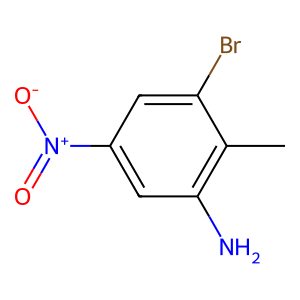
3-Bromo-2-methyl-5-nitroaniline
Names and Identifiers of 3-Bromo-2-methyl-5-nitroaniline
CAS Number |
1000342-34-6 |
|---|---|
MDL Number |
MFCD09880011 |
IUPAC Name |
3-bromo-2-methyl-5-nitroaniline |
InChI |
InChI=1S/C7H7BrN2O2/c1-4-6(8)2-5(10(11)12)3-7(4)9/h2-3H,9H2,1H3 |
InChIKey |
AORXQFQBVQILBL-UHFFFAOYSA-N |
Canonical SMILES |
CC1=C(C=C(C=C1Br)[N+](=O)[O-])N |
UNSPSC Code |
12352100 |
Physical and chemical properties of 3-Bromo-2-methyl-5-nitroaniline
Acidity coefficient |
1.09±0.10(Predicted) |
|---|---|
Boiling Point |
367.5±37.0 °C at 760 mmHg |
Density |
1.7±0.1 g/cm3 |
Exact Mass |
229.969086 |
Flash Point |
176.1±26.5 °C |
Index of Refraction |
1.649 |
LogP |
2.80 |
Molecular Formula |
C7H7BrN2O2 |
Molecular Weight |
231.047 |
PSA |
71.84000 |
Storage condition |
under inert gas (nitrogen or Argon) at 2–8 °C |
Vapour Pressure |
0.0±0.8 mmHg at 25°C |
Safety Information of 3-Bromo-2-methyl-5-nitroaniline

Applications of 3-Bromo-2-methyl-5-nitroaniline
3-Bromo-2-methyl-5-nitroaniline finds applications in various fields:
- Pharmaceuticals: Its derivatives are explored for potential antimicrobial agents.
- Dyes and Pigments: It serves as an intermediate in dye synthesis due to its reactive functional groups.
- Research: Used in organic synthesis as a building block for more complex molecules.
The versatility of this compound makes it valuable in both industrial and research settings.
Interaction Studies of 3-Bromo-2-methyl-5-nitroaniline
Studies on 3-Bromo-2-methyl-5-nitroaniline's interactions primarily focus on its biological activity. Research has demonstrated its potential effects against specific bacterial strains, which are essential for developing new antibiotics. Additionally, its interactions with other chemical agents during synthesis can influence reaction pathways and yield.
Biological Activity of 3-Bromo-2-methyl-5-nitroaniline
Research indicates that 3-Bromo-2-methyl-5-nitroaniline exhibits antimicrobial properties. Studies have shown that derivatives of 2-methyl-5-nitroaniline possess significant activity against various bacterial strains. The structure-activity relationship suggests that modifications to the aniline moiety can enhance or diminish biological efficacy.
Physical sample testing spectrum (NMR) of 3-Bromo-2-methyl-5-nitroaniline
