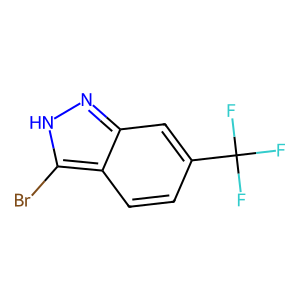
3-Bromo-6-(trifluoromethyl)-1H-indazole
CAS No.:
1000341-21-8
M. Wt:
265.030
M. Fa:
C8H4BrF3N2
InChI Key:
FZZHDSPRCRQGHN-UHFFFAOYSA-N
Appearance:
Yellow Solid
Names and Identifiers of 3-Bromo-6-(trifluoromethyl)-1H-indazole
CAS Number |
1000341-21-8 |
|---|---|
MDL Number |
MFCD09263228 |
IUPAC Name |
3-bromo-6-(trifluoromethyl)-2H-indazole |
InChI |
InChI=1S/C8H4BrF3N2/c9-7-5-2-1-4(8(10,11)12)3-6(5)13-14-7/h1-3H,(H,13,14) |
InChIKey |
FZZHDSPRCRQGHN-UHFFFAOYSA-N |
Canonical SMILES |
C1=CC2=C(NN=C2C=C1C(F)(F)F)Br |
UNSPSC Code |
12352100 |
Physical and chemical properties of 3-Bromo-6-(trifluoromethyl)-1H-indazole
Boiling Point |
328.1±37.0 °C at 760 mmHg |
|---|---|
Density |
1.8±0.1 g/cm3 |
Exact Mass |
263.950989 |
Flash Point |
152.3±26.5 °C |
Index of Refraction |
1.596 |
LogP |
3.46 |
Molecular Formula |
C8H4BrF3N2 |
Molecular Weight |
265.030 |
PSA |
28.68000 |
Storage condition |
2-8°C |
Vapour Pressure |
0.0±0.7 mmHg at 25°C |
Safety Information of 3-Bromo-6-(trifluoromethyl)-1H-indazole

Applications of 3-Bromo-6-(trifluoromethyl)-1H-indazole
3-Bromo-6-(trifluoromethyl)-1H-indazole has potential applications in several areas:
- Drug Development: Its unique structure makes it a candidate for developing new pharmaceuticals targeting bacterial infections or cancer.
- Chemical Synthesis: As a building block in organic synthesis, it can be used to create more complex molecules with specific biological activities.
- Material Science: The compound may also find applications in developing advanced materials due to its distinctive electronic properties imparted by the trifluoromethyl group.
Interaction Studies of 3-Bromo-6-(trifluoromethyl)-1H-indazole
Interaction studies are crucial for understanding the behavior of 3-Bromo-6-(trifluoromethyl)-1H-indazole in biological systems:
- Protein Binding Studies: Research into how this compound interacts with proteins can provide insights into its mechanism of action and therapeutic potential.
- Receptor Binding Assays: Investigating binding affinities to various receptors can help elucidate its pharmacological profile and potential side effects.
- Metabolism Studies: Understanding how this compound is metabolized in vivo will inform its safety and efficacy as a drug candidate.
Biological Activity of 3-Bromo-6-(trifluoromethyl)-1H-indazole
Research indicates that compounds containing indazole structures exhibit diverse biological activities, including:
- Antimicrobial Properties: Indazole derivatives have shown potential antibacterial activity against various pathogens, suggesting that 3-Bromo-6-(trifluoromethyl)-1H-indazole may serve as a lead compound in antibiotic development.
- Anticancer Activity: Some indazole derivatives demonstrate antiproliferative effects against cancer cell lines, indicating potential applications in cancer therapeutics.
- Neuroprotective Effects: Certain studies have suggested that indazoles may possess neuroprotective properties, opening avenues for research in neurodegenerative diseases.
Physical sample testing spectrum (NMR) of 3-Bromo-6-(trifluoromethyl)-1H-indazole
