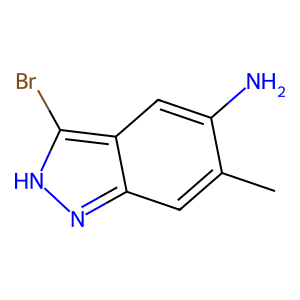
3-Bromo-6-methyl-1H-indazol-5-amine
Names and Identifiers of 3-Bromo-6-methyl-1H-indazol-5-amine
CAS Number |
1000343-43-0 |
|---|---|
EC Number |
864-394-3 |
MDL Number |
MFCD35098129 |
IUPAC Name |
3-bromo-6-methyl-2H-indazol-5-amine |
InChI |
InChI=1S/C8H8BrN3/c1-4-2-7-5(3-6(4)10)8(9)12-11-7/h2-3H,10H2,1H3,(H,11,12) |
InChIKey |
QANHUNMOMXHWPX-UHFFFAOYSA-N |
Canonical SMILES |
CC1=CC2=NNC(=C2C=C1N)Br |
UNSPSC Code |
12352100 |
Physical and chemical properties of 3-Bromo-6-methyl-1H-indazol-5-amine
Acidity coefficient |
12.81±0.40(Predicted) |
|---|---|
Boiling Point |
428.2±40.0 °C at 760 mmHg |
Density |
1.7±0.1 g/cm3 |
Exact Mass |
224.990158 |
Flash Point |
212.8±27.3 °C |
H Bond Acceptors |
2 |
H Bond Donors |
2 |
Index of Refraction |
1.759 |
LogP |
2.18 |
Molecular Formula |
C8H8BrN3 |
Molecular Weight |
226.073 |
PSA |
54.70000 |
Storage condition |
under inert gas (nitrogen or Argon) at 2–8 °C |
Vapour Pressure |
0.0±1.0 mmHg at 25°C |
Safety Information of 3-Bromo-6-methyl-1H-indazol-5-amine

Applications of 3-Bromo-6-methyl-1H-indazol-5-amine
3-Bromo-6-methyl-1H-indazol-5-amine has potential applications in:
- Drug Development: Its structural characteristics make it a promising candidate for designing new anticancer agents.
- Biochemical Research: It serves as a tool compound to study cellular mechanisms and signaling pathways involved in cancer progression.
Interaction Studies of 3-Bromo-6-methyl-1H-indazol-5-amine
Interaction studies indicate that 3-Bromo-6-methyl-1H-indazol-5-amine may act as an inhibitor for certain cytochrome P450 enzymes, specifically CYP1A2. This suggests that it could influence the metabolism of other drugs when co-administered. Understanding these interactions is crucial for predicting pharmacokinetic behaviors in vivo.
Biological Activity of 3-Bromo-6-methyl-1H-indazol-5-amine
3-Bromo-6-methyl-1H-indazol-5-amine exhibits notable biological activity, particularly in anticancer research. Studies have shown that derivatives of indazole can inhibit various cancer cell lines. For example, related compounds have demonstrated selective cytotoxicity against human chronic myeloid leukemia cells while sparing normal cells. The mechanism often involves apoptosis induction and modulation of key signaling pathways such as the p53/MDM2 pathway.
Physical sample testing spectrum (NMR) of 3-Bromo-6-methyl-1H-indazol-5-amine
