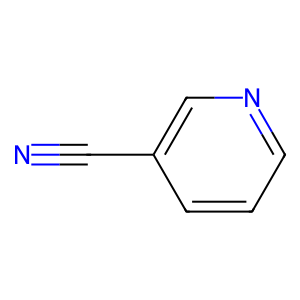
3-Cyanopyridine
CAS No.:
100-54-9
M. Wt:
104.109
M. Fa:
C6H4N2
InChI Key:
GZPHSAQLYPIAIN-UHFFFAOYSA-N
Appearance:
Pale-yellow Solid
Names and Identifiers of 3-Cyanopyridine
CAS Number |
100-54-9 |
|---|---|
EC Number |
202-863-0 |
MDL Number |
MFCD00006372 |
IUPAC Name |
pyridine-3-carbonitrile |
InChI |
InChI=1S/C6H4N2/c7-4-6-2-1-3-8-5-6/h1-3,5H |
InChIKey |
GZPHSAQLYPIAIN-UHFFFAOYSA-N |
Canonical SMILES |
C1=CC(=CN=C1)C#N |
UNII |
X64V0K6260 |
UNSPSC Code |
12352100 |
Physical and chemical properties of 3-Cyanopyridine
Acidity coefficient |
pK1:1.45(+1) (25°C) |
|---|---|
Boiling Point |
206.9 °C |
BRN |
107711 |
Density |
1.1590 @ 25 °C |
Exact Mass |
104.037445 |
Exposure Limits |
NIOSH: IDLH 25 mg/m3 |
Flash Point |
87 °C |
Index of Refraction |
1.540 |
LogP |
log Kow = 0.36 |
Melting Point |
51 °C |
Molecular Formula |
C6H4N2 |
Molecular Weight |
104.109 |
PSA |
36.68000 |
Solubility |
In water, 1.35X10+5 mg/l @ 20 °C |
Stability |
Incompatible with strong oxidizing agents, strong reducing agents, strong acids, strong bases. |
Storage condition |
Inert atmosphere,Room Temperature |
Vapour Pressure |
0.296 mm Hg @ 25 °C |
Water Solubility |
140 g/L (20 ºC) |
Safety Information of 3-Cyanopyridine

Key Milestone of 3-Cyanopyridine
| Time | Event | Description |
|---|---|---|
| Late 19th – early 20th century | Early studies on pyridine derivatives | Pyridine and its analogues were extensively investigated at the dawn of organic chemistry, laying the groundwork for the later synthesis of substituted pyridines such as 3-cyanopyridine. |
| 1930s–1940s | First reported synthesis of 3-cyanopyridine | The cyano group was introduced at the 3-position of the pyridine ring via electrophilic or nucleophilic substitution (e.g., Rosenmund–von Braun reaction), leading to the first unambiguous synthesis and characterization of 3-cyanopyridine. |
| 1950s–1960s | Exploration as an intermediate in organic synthesis | 3-Cyanopyridine began to be employed as a precursor for more complex nitrogen-containing heterocycles, showing promise in medicinal chemistry and agrochemical research. |
| 1970s | Role confirmed in nicotine metabolism | Biochemical studies identified 3-cyanopyridine as one of the oxidative metabolites of nicotine in humans or the environment, prompting interest in its toxicological properties. |
| 1980s–1990s | Scale-up as an intermediate for pesticides and pharmaceuticals | It became a key building block for neonicotinoid insecticides (e.g., imidacloprid, acetamiprid) and was used to prepare anti-tuberculosis drugs (e.g., isoniazid analogues) and other therapeutic agents. |
| 2000s | Development of greener synthetic routes | To address environmental concerns associated with traditional methods (e.g., the use of highly toxic cyanides), safer and more efficient catalytic cyanation processes were introduced (e.g., using K₄[Fe(CN)₆] or transition-metal catalysis). |
| 2010s–present | Establishment as a versatile platform molecule | Widely applied in the synthesis of vitamin B₃ (niacin), antiviral drugs, metal ligands, and functional materials; also serves as a reference standard in analytical chemistry and metabolomics. |
Applications of 3-Cyanopyridine
3-Cyanopyridine is utilized in various applications:
- Pharmaceuticals: It serves as an intermediate in the synthesis of drugs and active pharmaceutical ingredients.
- Agricultural Chemicals: The compound is involved in producing agrochemicals that enhance crop yield and pest resistance.
- Chemical Synthesis: It acts as a building block for synthesizing more complex organic molecules used in research and industry.
Interaction Studies of 3-Cyanopyridine
Research on the interactions of 3-cyanopyridine with biological systems reveals:
- Enzymatic Hydrolysis: Studies show that immobilized strains of Rhodococcus rhodochrous can effectively hydrolyze 3-cyanopyridine to nicotinamide, indicating potential biotechnological applications .
- Pharmacological Potential: Investigations into its pharmacological properties suggest that derivatives of 3-cyanopyridine may exhibit anti-inflammatory or anti-cancer activities.
Biological Activity of 3-Cyanopyridine
3-Cyanopyridine exhibits notable biological activities:
- Precursor to Vitamins: It is a precursor for nicotinamide, which is essential for various biological processes, including energy metabolism and DNA repair .
- Enzymatic Reactions: The compound can be converted into biologically active forms through enzymatic reactions, highlighting its significance in biochemical pathways .
Physical sample testing spectrum (NMR) of 3-Cyanopyridine

 Cas:109-77-3

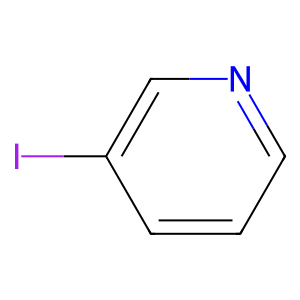 Cas:1120-90-7

 Cas:143-33-9
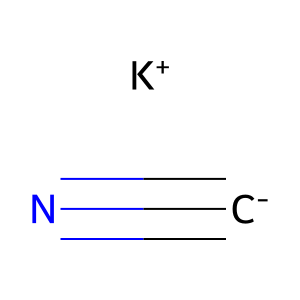 Cas:151-50-8