
3-Cyclohexene-1-carboxaldehyde
CAS No.:
100-50-5
M. Wt:
110.154
M. Fa:
C7H10O
InChI Key:
DCFDVJPDXYGCOK-UHFFFAOYSA-N
Appearance:
Colorless liquid
Names and Identifiers of 3-Cyclohexene-1-carboxaldehyde
CAS Number |
100-50-5 |
|---|---|
EC Number |
202-858-3 |
MDL Number |
MFCD00001572 |
IUPAC Name |
cyclohex-3-ene-1-carbaldehyde |
InChI |
InChI=1S/C7H10O/c8-6-7-4-2-1-3-5-7/h1-2,6-7H,3-5H2 |
InChIKey |
DCFDVJPDXYGCOK-UHFFFAOYSA-N |
Canonical SMILES |
C1CC(CC=C1)C=O |
UNII |
GAK9539347 |
UNSPSC Code |
12352100 |
UN Number |
2498 |
Physical and chemical properties of 3-Cyclohexene-1-carboxaldehyde
Boiling Point |
105 °C |
|---|---|
BRN |
774001 |
Density |
0.9694 @ 20 °C/4 °C |
Exact Mass |
110.073166 |
Flash Point |
135 °F (57 °C) (OPEN CUP) |
Index of Refraction |
MAXIMUM ABSORPTION (ETHANOL): 231 NM (LOG E= 4.12); INDEX OF REFRACTION: 1.5005 @ 20 °C/D |
LogP |
1.59 |
Melting Point |
2 °C |
Molecular Formula |
C7H10O |
Molecular Weight |
110.154 |
PSA |
17.07000 |
Sensitivity |
Air Sensitive |
Solubility |
Slightly soluble in water. |
Stability |
Stable. Incompatible with strong oxidizing agents, strong bases, strong reducing agents. |
Storage condition |
2-8°C |
Vapour density |
3.8 (vs air) |
Vapour Pressure |
1.8 [mmHg] |
Water Solubility |
11.5g/L at 20℃ |
Safety Information of 3-Cyclohexene-1-carboxaldehyde


Applications of 3-Cyclohexene-1-carboxaldehyde
3-Cyclohexene-1-carboxaldehyde finds applications in various fields:
- Chemical Intermediates: It serves as a precursor in the synthesis of more complex organic molecules, including pharmaceuticals and agrochemicals.
- Fragrance Industry: Due to its unique odor profile, it is utilized in the formulation of fragrances and flavorings.
- Polymer Chemistry: It is employed in the production of polymers and resins, contributing to materials science applications.
Interaction Studies of 3-Cyclohexene-1-carboxaldehyde
Studies on the interactions of 3-cyclohexene-1-carboxaldehyde with other compounds have revealed interesting insights:
- Reactivity with Nucleophiles: The compound readily reacts with nucleophiles such as amines and alcohols, forming various derivatives that may possess enhanced biological activities.
- Compatibility with Catalysts: Its reactions can be facilitated by specific catalysts, enhancing yield and selectivity during synthetic processes.
These interaction studies are crucial for understanding its potential applications and optimizing its use in chemical synthesis.
Biological Activity of 3-Cyclohexene-1-carboxaldehyde
Research indicates that 3-cyclohexene-1-carboxaldehyde exhibits various biological activities, including:
- Antimicrobial Properties: Some studies have suggested that this compound can inhibit the growth of certain bacteria and fungi.
- Potential Anti-inflammatory Effects: Preliminary data indicate that it may possess anti-inflammatory properties, although further research is needed to confirm these effects.
- Cytotoxicity: There are indications that it may exhibit cytotoxic effects against specific cancer cell lines, making it a candidate for further investigation in cancer research.
Physical sample testing spectrum (NMR) of 3-Cyclohexene-1-carboxaldehyde

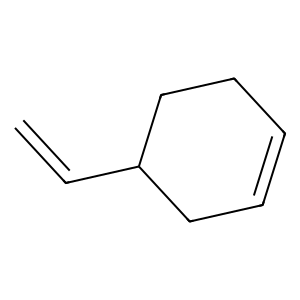 Cas:100-40-3

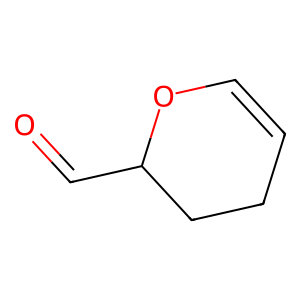 Cas:100-73-2
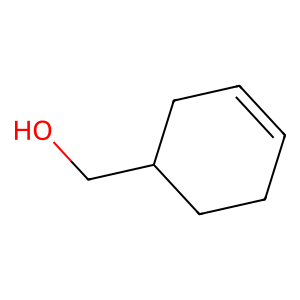 Cas:1679-51-2