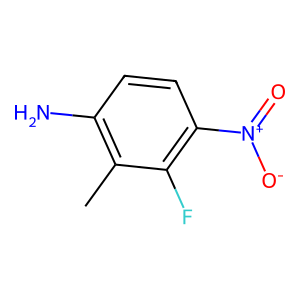
3-Fluoro-2-methyl-4-nitroaniline
Names and Identifiers of 3-Fluoro-2-methyl-4-nitroaniline
CAS Number |
1000342-98-2 |
|---|---|
IUPAC Name |
3-fluoro-2-methyl-4-nitroaniline |
InChI |
InChI=1S/C7H7FN2O2/c1-4-5(9)2-3-6(7(4)8)10(11)12/h2-3H,9H2,1H3 |
InChIKey |
NFWVJCKMVIGVLF-UHFFFAOYSA-N |
Canonical SMILES |
CC1=C(C=CC(=C1F)[N+](=O)[O-])N |
Physical and chemical properties of 3-Fluoro-2-methyl-4-nitroaniline
Exact Mass |
170.04900 |
|---|---|
LogP |
2.72890 |
Molecular Formula |
C7H7FN2O2 |
Molecular Weight |
170.14100 |
PSA |
71.84000 |
Storage condition |
2-8℃ |
Safety Information of 3-Fluoro-2-methyl-4-nitroaniline

Applications of 3-Fluoro-2-methyl-4-nitroaniline
3-Fluoro-2-methyl-4-nitroaniline has diverse applications across various fields:
- Organic Synthesis: It serves as an intermediate in synthesizing more complex organic molecules.
- Pharmaceutical Development: Investigated for potential use in drug development as a building block for pharmaceutical compounds.
- Dyes and Pigments Production: Utilized in manufacturing dyes and pigments due to its vibrant color properties.
- Agrochemicals: Employed in the formulation of agrochemical products.
Interaction Studies of 3-Fluoro-2-methyl-4-nitroaniline
Studies on the interactions of 3-Fluoro-2-methyl-4-nitroaniline with biological systems have demonstrated its potential role as an enzyme probe. Its derivatives can interact with various biomolecules, providing insights into their mechanisms of action and aiding in the development of targeted therapies.
Biological Activity of 3-Fluoro-2-methyl-4-nitroaniline
Research indicates that 3-Fluoro-2-methyl-4-nitroaniline exhibits biological activity that makes it a candidate for further investigation in medicinal chemistry. Its derivatives have been studied for their potential as antimicrobial agents and in enzyme interactions. The presence of the nitro group may enhance its biological activity through mechanisms such as reactive oxygen species generation or interference with cellular processes.