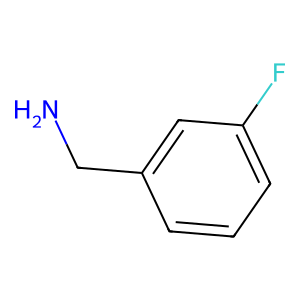
3-Fluorobenzylamine
CAS No.:
100-82-3
M. Wt:
125.144
M. Fa:
C7H8FN
InChI Key:
QVSVMNXRLWSNGS-UHFFFAOYSA-N
Appearance:
Colorless Liquid
Names and Identifiers of 3-Fluorobenzylamine
CAS Number |
100-82-3 |
|---|---|
EC Number |
202-891-3 |
MDL Number |
MFCD00008113 |
IUPAC Name |
(3-fluorophenyl)methanamine |
InChI |
InChI=1S/C7H8FN/c8-7-3-1-2-6(4-7)5-9/h1-4H,5,9H2 |
InChIKey |
QVSVMNXRLWSNGS-UHFFFAOYSA-N |
Canonical SMILES |
C1=CC(=CC(=C1)F)CN |
UNII |
6MGA6423TQ |
UNSPSC Code |
12352100 |
Physical and chemical properties of 3-Fluorobenzylamine
Acidity coefficient |
8.80±0.10(Predicted) |
|---|---|
Boiling Point |
175.8±15.0 °C at 760 mmHg |
BRN |
1446928 |
Density |
1.1±0.1 g/cm3 |
Exact Mass |
125.064079 |
Flash Point |
71.1±0.0 °C |
Index of Refraction |
1.523 |
LogP |
1.14 |
Melting Point |
247-248 °C(Solv: N,N-dimethylformamide (68-12-2)) |
Molecular Formula |
C7H8FN |
Molecular Weight |
125.144 |
PSA |
26.02000 |
Sensitivity |
Air Sensitive |
Storage condition |
2-8°C |
Vapour Pressure |
1.1±0.3 mmHg at 25°C |
Solubility of 3-Fluorobenzylamine
| Solvent Category | Solvent Name | Dissolution Phenomenon | Temperature Effect | pH Effect |
|---|---|---|---|---|
| Protic Solvents | Water | Slightly soluble or insoluble | Increased temperature slightly improves solubility | Solubility significantly increases under acidic conditions (salt formation) |
| Protic Solvents | Ethanol | Soluble | Solubility increases with rising temperature | Less pH effect; dissolves better in acidic conditions |
| Protic Solvents | Methanol | Soluble | Rising temperature helps dissolution | Acidic conditions enhance solubility |
| Polar Aprotic Solvents | DMSO | Freely soluble | Good solubility, temperature has little effect | pH has little influence |
| Polar Aprotic Solvents | DMF | Soluble | Increased temperature helps increase dissolution rate | pH has little influence |
| Nonpolar Solvents | Ether | Insoluble | Nearly insoluble, heating does not significantly improve solubility | pH has no significant effect |
| Nonpolar Solvents | Hexane | Completely insoluble | Completely insoluble | pH has no significant effect |
| Acidic Solvents | Dilute Hydrochloric Acid | Freely soluble (salt formation) | Elevated temperature aids reaction and dissolution | Acidic conditions significantly enhance solubility |
| Basic Solvents | Sodium Hydroxide Aqueous Solution | Low solubility or precipitation | Low temperature may promote precipitation | At high pH, solubility decreases, free amine may precipitate |
Safety Information of 3-Fluorobenzylamine

Key Milestone of 3-Fluorobenzylamine
| Time (Year) | Event/Milestone | Description |
|---|---|---|
| 1950s–1960s | Initial Synthesis and Structural Confirmation | As one of the aromatic fluoroamine compounds, 3-fluorobenzylamine was synthesized in the early development of organic fluorine chemistry for basic organic synthesis research. Its structure was confirmed using emerging techniques such as nuclear magnetic resonance (NMR) and infrared spectroscopy (IR) at that time. |
| 1970s–1980s | Widely Used as an Organic Synthesis Intermediate | With the development of medicinal chemistry, 3-fluorobenzylamine became widely used as a building block for constructing complex molecules due to its fluoroaromatic ring and primary amine functional group, especially playing an important role in the synthesis of fluorinated drugs and agrochemicals. |
| 1990s | Emergence as a Key Intermediate in Drug Development | Several pharmaceutical companies used it in the synthesis of bioactive candidate compounds, such as antidepressants, antihistamines, and precursors for central nervous system (CNS) active molecules. The introduction of fluorine atoms can improve pharmacokinetic properties (e.g., metabolic stability, lipophilicity). |
| 2000s | Commercial Supply and Standardization | Major chemical reagent suppliers (such as Sigma-Aldrich, TCI, Alfa Aesar, etc.) began large-scale commercial supply of 3-fluorobenzylamine with purity above 97%, promoting its widespread use in both academia and industry. |
| 2010s | Expanded Applications in New Drugs and Materials | It has been used in the synthesis of targeted kinase inhibitors, G protein-coupled receptor (GPCR) ligands, and other new drugs; meanwhile, it also appears as a functional unit in the design of organic optoelectronic materials and liquid crystal molecules. |
| 2020s | Green Synthesis and Sustainable Process Research | Research focuses on more environmentally friendly synthetic pathways (e.g., catalytic hydrogenation, electrochemical reduction), reducing environmental burdens caused by highly toxic reagents (such as cyanides) in traditional methods and improving atom economy. |
Applications of 3-Fluorobenzylamine
3-Fluorobenzylamine finds applications in various fields:
- Pharmaceutical Chemistry: It serves as an intermediate in the synthesis of pharmaceuticals and agrochemicals.
- Material Science: Used in the development of functional materials due to its unique electronic properties.
- Coordination Chemistry: Acts as a ligand in metal complex formation, which may have implications in catalysis and drug design.
Interaction Studies of 3-Fluorobenzylamine
Interaction studies involving 3-Fluorobenzylamine often focus on its role as a ligand in coordination compounds. These studies assess how variations in the ligand structure affect the stability and reactivity of metal complexes. The nature of interactions between 3-Fluorobenzylamine and metal ions can influence biological activity, making it a subject of interest for researchers exploring new therapeutic agents.
Physical sample testing spectrum (NMR) of 3-Fluorobenzylamine

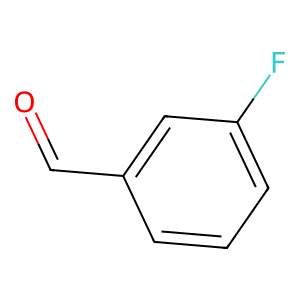 Cas:456-48-4

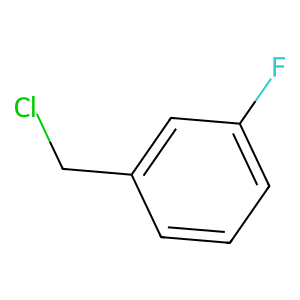 Cas:456-42-8
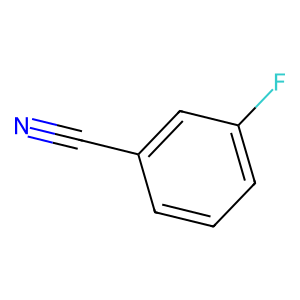 Cas:403-54-3