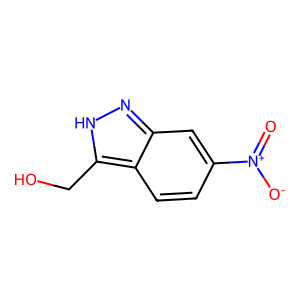
3-HYDROXYMETHYL-6-NITRO 1H-INDAZOLE
CAS No.:
1000341-10-5
M. Wt:
193.160
M. Fa:
C8H7N3O3
InChI Key:
-
Names and Identifiers of 3-HYDROXYMETHYL-6-NITRO 1H-INDAZOLE
CAS Number |
1000341-10-5 |
|---|---|
IUPAC Name |
(6-nitro-2H-indazol-3-yl)methanol |
Canonical SMILES |
C1=CC2=C(NN=C2C=C1[N+](=O)[O-])CO |
Physical and chemical properties of 3-HYDROXYMETHYL-6-NITRO 1H-INDAZOLE
Acidity coefficient |
11.08±0.40(Predicted) |
|---|---|
Boiling Point |
483.6±30.0 °C at 760 mmHg |
Density |
1.6±0.1 g/cm3 |
Exact Mass |
193.048737 |
Flash Point |
246.3±24.6 °C |
Index of Refraction |
1.759 |
LogP |
0.88 |
Molecular Formula |
C8H7N3O3 |
Molecular Weight |
193.160 |
PSA |
94.73000 |
Storage condition |
2-8°C |
Vapour Pressure |
0.0±1.3 mmHg at 25°C |
Applications of 3-HYDROXYMETHYL-6-NITRO 1H-INDAZOLE
(6-Nitro-1H-indazol-3-yl)methanol has diverse applications across several fields:
- Pharmaceutical Development: Its biological activities make it a candidate for developing new therapeutic agents targeting specific diseases.
- Organic Synthesis: The compound serves as a building block for synthesizing more complex indazole derivatives used in various chemical applications.
- Specialty Chemicals Production: Due to its unique properties, it is utilized in producing dyes, pigments, and other specialty chemicals.
Interaction Studies of 3-HYDROXYMETHYL-6-NITRO 1H-INDAZOLE
Studies on the interactions of (6-Nitro-1H-indazol-3-yl)methanol with biological systems indicate that it may interact with specific enzymes or receptors involved in disease pathways. For instance, some indazole derivatives have been shown to inhibit enzymes related to inflammation and cancer progression. Further research is needed to fully characterize these interactions and their implications for drug design.
Biological Activity of 3-HYDROXYMETHYL-6-NITRO 1H-INDAZOLE
Research indicates that (6-Nitro-1H-indazol-3-yl)methanol exhibits significant biological activities:
- Antimicrobial Properties: Compounds in the indazole class have shown potential against various bacterial and fungal strains, suggesting that (6-Nitro-1H-indazol-3-yl)methanol may possess similar antimicrobial efficacy.
- Anti-inflammatory Effects: Studies indicate that some indazole derivatives can inhibit pro-inflammatory cytokines, potentially making (6-Nitro-1H-indazol-3-yl)methanol useful in treating inflammatory conditions.
- Anticancer Activity: Preliminary investigations suggest that this compound may inhibit cell growth and induce apoptosis in cancer cells, positioning it as a candidate for further drug development.