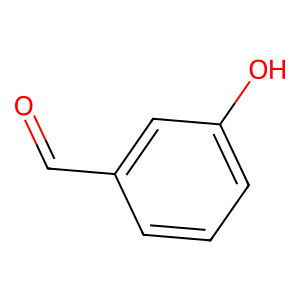
3-Hydroxybenzaldehyde
Names and Identifiers of 3-Hydroxybenzaldehyde
CAS Number |
100-83-4 |
|---|---|
EC Number |
202-892-9 |
MDL Number |
MFCD00003368 |
IUPAC Name |
3-hydroxybenzaldehyde |
InChI |
InChI=1S/C7H6O2/c8-5-6-2-1-3-7(9)4-6/h1-5,9H |
InChIKey |
IAVREABSGIHHMO-UHFFFAOYSA-N |
Canonical SMILES |
C1=CC(=CC(=C1)O)C=O |
UNII |
8Z2819J40E |
UNSPSC Code |
12352100 |
Physical and chemical properties of 3-Hydroxybenzaldehyde
Acidity coefficient |
8.98(at 25℃) |
|---|---|
Boiling Point |
240.9±13.0 °C at 760 mmHg |
BRN |
507099 |
Density |
1.2±0.1 g/cm3 |
Exact Mass |
122.036781 |
Flash Point |
98.6±12.4 °C |
Index of Refraction |
1.618 |
LogP |
1.25 |
Melting Point |
100-103 °C(lit.) |
Molecular Formula |
C7H6O2 |
Molecular Weight |
122.121 |
pH |
3-4 (H2O, 20℃)(saturated solution) |
PSA |
37.30000 |
Sensitivity |
Air Sensitive |
Solubility |
Soluble in DMSO and Methanol |
Storage condition |
Inert atmosphere,2-8°C |
Vapour Pressure |
0.01 [mmHg] |
Water Solubility |
SOLUBLE |
Solubility of 3-Hydroxybenzaldehyde
| Solvent Category | Solvent Name | Dissolution Behavior | Temperature Effect | pH Effect |
|---|---|---|---|---|
| Polar Solvents | Water | Slightly soluble | Solubility slightly increases with rising temperature | Significantly increased solubility under alkaline conditions (phenolic hydroxyl group forms salt) |
| Alcohol (Ethanol) | Readily soluble | Solubility increases with rising temperature | Minimal pH effect | |
| Methanol | Readily soluble | Solubility increases with rising temperature | Minimal pH effect | |
| Nonpolar Solvents | n-Hexane | Insoluble | No significant change | Minimal pH influence |
| Benzene | Slightly soluble to insoluble | Mild improvement with increasing temperature | Minor pH effect | |
| Diethyl Ether | Soluble | Solubility slightly increases with rising temperature | Minimal pH influence | |
| Protic Solvents | Propylene Glycol | Soluble | Increased temperature enhances solubility | Minimal pH effect |
| Glycerol | Soluble | Higher temperature improves solubility | Better solubility under alkaline conditions | |
| Strongly Alkaline Solvents | Sodium Hydroxide Solution | Readily soluble (forms phenoxide salt) | Higher temperature accelerates dissolution rate | Phenolic hydroxyl group deprotonates under alkaline conditions, significantly enhancing solubility |
Safety Information of 3-Hydroxybenzaldehyde

Key Milestone of 3-Hydroxybenzaldehyde
| Year | Event Description | Key Progress/Significance |
|---|---|---|
| 1870s | Initial Synthesis and Structural Confirmation | As a hydroxy derivative of benzaldehyde, meta-hydroxybenzaldehyde was first synthesized in the late 19th century by organic chemists through formylation reactions of phenolic compounds. Its structure was gradually confirmed during studies on aromatic substitution patterns. |
| 1920s–1940s | Early Research as an Organic Synthesis Intermediate | It was explored as an intermediate in dye and fragrance chemistry due to its dual functional groups (aldehyde and phenolic hydroxyl), attracting attention for its multifunctional reactivity in synthetic chemistry. |
| 1950s | Initial Application in Pharmaceutical Synthesis | It became a building block for various pharmaceutical intermediates, such as modifications of aromatic ring scaffolds in anti-inflammatory drugs and cardiovascular medications. |
| 1960s–1970s | Establishment of Analytical Methods | The development of infrared spectroscopy (IR), nuclear magnetic resonance (NMR), and gas chromatography-mass spectrometry (GC-MS) enabled more accurate purity analysis and structural identification of meta-hydroxybenzaldehyde, promoting its standardized use in research. |
| 1980s | Expansion of Applications in Coordination Chemistry | Due to its ability for metal coordination via both the phenolic hydroxyl and aldehyde groups, it was used as a precursor for synthesizing Schiff base ligands, widely applied in the design of transition metal catalysts. |
| 1990s | Natural Product Mimicry and Bioactivity Studies | Its structure was found to exist in certain plant secondary metabolites, prompting studies on its potential antioxidant and antibacterial bioactivities, extending into the field of natural product mimicry. |
| 2000s | Development of Green Synthetic Methods | Researchers developed environmentally friendly synthesis pathways, such as microwave-assisted synthesis, green solvents, or enzymatic catalysis, to improve yields while reducing environmental impact. |
| 2010s | Exploration of Applications in Functional Materials | It emerged as a linking unit in covalent organic frameworks (COFs) or metal-organic frameworks (MOFs) due to its rigid aromatic structure and dual functionality, drawing attention from materials science. |
| 2020s to Present | Studies on Anticancer and Neuroprotective Activities | Multiple in vitro studies have shown that its derivatives exhibit tumor cell proliferation inhibition and antioxidant stress capacity, making them promising lead compounds for drug development and optimization. |
Applications of 3-Hydroxybenzaldehyde
3-Hydroxybenzaldehyde finds applications across various fields:
- Organic Synthesis: It is utilized as an intermediate in synthesizing pharmaceuticals and agrochemicals.
- Sensor Development: The compound is employed in creating selective sensors for metal ions like terbium(III).
- Biological Research: Its properties make it useful in studying vascular biology and potential therapeutic interventions.
Interaction Studies of 3-Hydroxybenzaldehyde
Studies have shown that 3-hydroxybenzaldehyde interacts with various biological systems. Its vasculoprotective effects suggest interactions at cellular levels, particularly affecting smooth muscle cell proliferation and endothelial cell function. Further research is needed to fully elucidate its mechanisms of action and potential interactions with other pharmacological agents.
Biological Activity of 3-Hydroxybenzaldehyde
3-Hydroxybenzaldehyde exhibits notable biological properties. Research indicates that it has vasculoprotective effects, particularly by reducing the proliferation of vascular smooth muscle cells and mitigating inflammation in endothelial cells. These properties suggest potential therapeutic applications in cardiovascular diseases. Additionally, it serves as a precursor in the synthesis of various bioactive compounds, including monastrol, which is known for its anti-cancer properties.
Physical sample testing spectrum (NMR) of 3-Hydroxybenzaldehyde

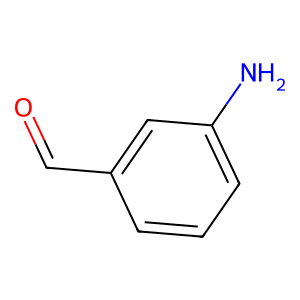 Cas:1709-44-0

 Cas:587-04-2
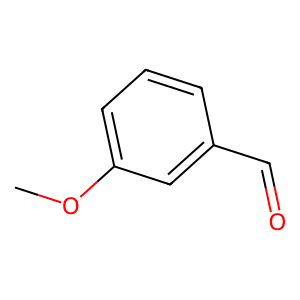 Cas:591-31-1