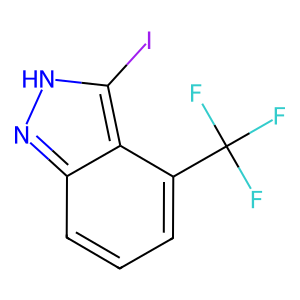
3-Iodo-4-(trifluoromethyl)-1H-indazole
Names and Identifiers of 3-Iodo-4-(trifluoromethyl)-1H-indazole
CAS Number |
1000341-14-9 |
|---|---|
MDL Number |
MFCD09263214 |
IUPAC Name |
3-iodo-4-(trifluoromethyl)-2H-indazole |
InChI |
InChI=1S/C8H4F3IN2/c9-8(10,11)4-2-1-3-5-6(4)7(12)14-13-5/h1-3H,(H,13,14) |
InChIKey |
UZNAFBYLDZTQQK-UHFFFAOYSA-N |
Canonical SMILES |
C1=CC2=NNC(=C2C(=C1)C(F)(F)F)I |
UNSPSC Code |
12352100 |
Physical and chemical properties of 3-Iodo-4-(trifluoromethyl)-1H-indazole
Boiling Point |
352.0±37.0 °C at 760 mmHg |
|---|---|
Density |
2.1±0.1 g/cm3 |
Exact Mass |
311.937103 |
Flash Point |
166.7±26.5 °C |
Index of Refraction |
1.643 |
LogP |
3.72 |
Molecular Formula |
C8H4F3IN2 |
Molecular Weight |
312.030 |
PSA |
28.68000 |
Storage condition |
2-8°C |
Vapour Pressure |
0.0±0.7 mmHg at 25°C |
Safety Information of 3-Iodo-4-(trifluoromethyl)-1H-indazole

Applications of 3-Iodo-4-(trifluoromethyl)-1H-indazole
This compound has diverse applications across several fields:
- Chemical Research: It serves as a building block in organic synthesis and as a reagent in various transformations.
- Biological Studies: It is utilized in exploring biological pathways and enzyme activities.
- Agrochemicals: The compound is being investigated for potential use in developing agrochemicals due to its unique properties.
Interaction Studies of 3-Iodo-4-(trifluoromethyl)-1H-indazole
Research into the interaction of 3-Iodo-4-(trifluoromethyl)-1H-indazole with biological targets has revealed its potential as a drug candidate. Its interactions are characterized by halogen bonding due to the iodine atom, which can enhance binding affinity towards specific proteins and receptors. Studies have indicated that it may influence metabolic pathways involving cytochrome P450 enzymes, showcasing its significance in pharmacology.
Biological Activity of 3-Iodo-4-(trifluoromethyl)-1H-indazole
3-Iodo-4-(trifluoromethyl)-1H-indazole exhibits notable biological activity. It has been investigated for its potential as a pharmacological agent due to its ability to interact with various biological pathways. Specific studies have shown that it can inhibit certain cytochrome P450 enzymes, which are crucial for drug metabolism, indicating its relevance in drug discovery and development. Its lipophilicity, enhanced by the trifluoromethyl group, allows it to effectively penetrate biological membranes.