
3-Iodo-6-(trifluoromethyl)-1H-indazole
Names and Identifiers of 3-Iodo-6-(trifluoromethyl)-1H-indazole
CAS Number |
1000341-27-4 |
|---|---|
MDL Number |
MFCD09263230 |
IUPAC Name |
3-iodo-6-(trifluoromethyl)-2H-indazole |
InChI |
InChI=1S/C8H4F3IN2/c9-8(10,11)4-1-2-5-6(3-4)13-14-7(5)12/h1-3H,(H,13,14) |
InChIKey |
ARPPCBLAYCXFHA-UHFFFAOYSA-N |
Canonical SMILES |
C1=CC2=C(NN=C2C=C1C(F)(F)F)I |
UNSPSC Code |
12352100 |
Physical and chemical properties of 3-Iodo-6-(trifluoromethyl)-1H-indazole
Boiling Point |
352.0±37.0 °C at 760 mmHg |
|---|---|
Density |
2.1±0.1 g/cm3 |
Exact Mass |
311.937103 |
Flash Point |
166.7±26.5 °C |
Index of Refraction |
1.643 |
LogP |
3.72 |
Molecular Formula |
C8H4F3IN2 |
Molecular Weight |
312.030 |
PSA |
28.68000 |
Storage condition |
2-8°C(protect from light) |
Vapour Pressure |
0.0±0.7 mmHg at 25°C |
Safety Information of 3-Iodo-6-(trifluoromethyl)-1H-indazole

Applications of 3-Iodo-6-(trifluoromethyl)-1H-indazole
3-Iodo-6-(trifluoromethyl)-1H-indazole has several applications:
- Chemical Research: It serves as a building block for synthesizing more complex molecules and as a reagent in organic transformations.
- Biological Studies: Utilized as a probe for investigating enzyme activities and biological pathways.
- Industrial Use: Employed in developing agrochemicals and materials with enhanced stability and reactivity.
Interaction Studies of 3-Iodo-6-(trifluoromethyl)-1H-indazole
Studies on the interactions of 3-Iodo-6-(trifluoromethyl)-1H-indazole reveal its potential in influencing biological systems. Its lipophilicity allows it to penetrate cellular membranes effectively, while its halogen bonding capability may enhance its binding selectivity towards specific proteins or enzymes. Further research is required to elucidate its complete mechanism of action within biological contexts.
Biological Activity of 3-Iodo-6-(trifluoromethyl)-1H-indazole
The biological activity of 3-Iodo-6-(trifluoromethyl)-1H-indazole is notable due to its interaction with specific molecular targets. The trifluoromethyl group enhances its interaction with biological membranes and proteins, while the iodine atom can facilitate halogen bonding, potentially increasing binding affinity to targets. Research indicates that compounds with similar structures can influence various biological pathways, including enzyme activities and cellular responses to stress.
Physical sample testing spectrum (NMR) of 3-Iodo-6-(trifluoromethyl)-1H-indazole

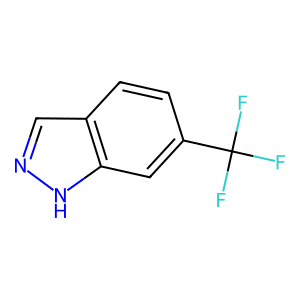 Cas:954239-22-6
