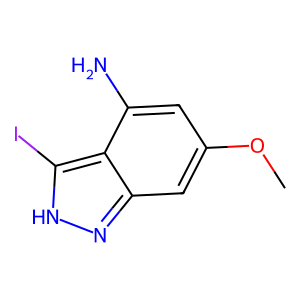
3-Iodo-6-methoxy-1H-indazol-4-amine
Names and Identifiers of 3-Iodo-6-methoxy-1H-indazol-4-amine
CAS Number |
1000341-17-2 |
|---|---|
IUPAC Name |
3-iodo-6-methoxy-2H-indazol-4-amine |
InChI |
InChI=1S/C8H8IN3O/c1-13-4-2-5(10)7-6(3-4)11-12-8(7)9/h2-3H,10H2,1H3,(H,11,12) |
InChIKey |
MQUKUKJEOFDJAO-UHFFFAOYSA-N |
Canonical SMILES |
COC1=CC2=NNC(=C2C(=C1)N)I |
Physical and chemical properties of 3-Iodo-6-methoxy-1H-indazol-4-amine
Boiling Point |
485.0±40.0 °C at 760 mmHg |
|---|---|
Density |
2.0±0.1 g/cm3 |
Exact Mass |
288.971191 |
Flash Point |
247.1±27.3 °C |
Index of Refraction |
1.784 |
LogP |
1.77 |
Molecular Formula |
C8H8IN3O |
Molecular Weight |
289.073 |
PSA |
63.93000 |
Vapour Pressure |
0.0±1.2 mmHg at 25°C |
Applications of 3-Iodo-6-methoxy-1H-indazol-4-amine
3-Iodo-6-methoxy-1H-indazol-4-amine has potential applications in several fields:
- Pharmaceuticals: Due to its enzyme inhibition properties, it may serve as a lead compound in drug discovery for treating conditions associated with MAO activity.
- Materials Science: The unique properties of indazole derivatives make them suitable for use in organic electronics and photonic devices.
Further research is necessary to fully explore its applications in these areas.
Interaction Studies of 3-Iodo-6-methoxy-1H-indazol-4-amine
Interaction studies are crucial for understanding how 3-Iodo-6-methoxy-1H-indazol-4-amine interacts with biological systems. Preliminary data suggest that:
- The compound may act as a substrate or inhibitor for specific cytochrome P450 enzymes, which are vital for drug metabolism.
Detailed pharmacokinetic studies are required to elucidate its absorption, distribution, metabolism, and excretion profiles.
Biological Activity of 3-Iodo-6-methoxy-1H-indazol-4-amine
Research indicates that 3-Iodo-6-methoxy-1H-indazol-4-amine exhibits significant biological activities, particularly as an inhibitor of certain enzymes. Its structural features suggest potential interactions with biological targets, which may include:
- Inhibition of monoamine oxidase (MAO): Substituents on indazole derivatives have been shown to influence MAO inhibition, suggesting that this compound may possess similar activity.
The compound's biological profile is still under investigation, but preliminary studies indicate promising therapeutic applications.