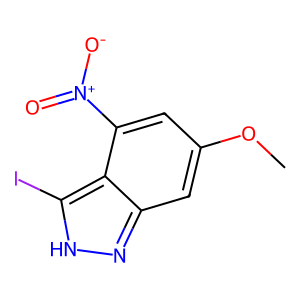
3-Iodo-6-methoxy-4-nitro-1H-indazole
Names and Identifiers of 3-Iodo-6-methoxy-4-nitro-1H-indazole
CAS Number |
1000341-12-7 |
|---|---|
IUPAC Name |
3-iodo-6-methoxy-4-nitro-2H-indazole |
InChI |
InChI=1S/C8H6IN3O3/c1-15-4-2-5-7(8(9)11-10-5)6(3-4)12(13)14/h2-3H,1H3,(H,10,11) |
InChIKey |
MVRUMBZYNRQEIK-UHFFFAOYSA-N |
Canonical SMILES |
COC1=CC2=NNC(=C2C(=C1)[N+](=O)[O-])I |
Physical and chemical properties of 3-Iodo-6-methoxy-4-nitro-1H-indazole
Boiling Point |
497.9±40.0 °C at 760 mmHg |
|---|---|
Density |
2.1±0.1 g/cm3 |
Exact Mass |
318.945374 |
Flash Point |
254.9±27.3 °C |
Index of Refraction |
1.757 |
LogP |
3.10 |
Molecular Formula |
C8H6IN3O3 |
Molecular Weight |
319.056 |
PSA |
83.73000 |
Vapour Pressure |
0.0±1.2 mmHg at 25°C |
Applications of 3-Iodo-6-methoxy-4-nitro-1H-indazole
This compound has potential applications in medicinal chemistry, particularly in drug development for cancer and neurodegenerative diseases. Its unique structure allows it to serve as a lead compound for further modifications aimed at enhancing efficacy and reducing toxicity. Additionally, it may find use in materials science due to its electronic properties.
Interaction Studies of 3-Iodo-6-methoxy-4-nitro-1H-indazole
Interaction studies involving 3-Iodo-6-methoxy-4-nitro-1H-indazole focus on its binding affinity to various biological targets, including enzymes and receptors. Preliminary studies suggest that it may inhibit specific enzymes involved in cancer progression or neurodegeneration, although detailed investigations are necessary to elucidate its mechanisms of action.
Biological Activity of 3-Iodo-6-methoxy-4-nitro-1H-indazole
3-Iodo-6-methoxy-4-nitro-1H-indazole exhibits significant biological activity, particularly in pharmacological contexts. Compounds with similar structures have been studied for their potential as anticancer agents and in the treatment of neurological disorders. The presence of both the methoxy and nitro groups may contribute to its bioactivity by influencing the compound's interaction with biological targets.