![structure of 3-Methyl-[1,2,4]triazolo[4,3-a]pyridine](https://molwiki.oss-cn-hongkong.aliyuncs.com/structure/65/1004-65-5.svg)
3-Methyl-[1,2,4]triazolo[4,3-a]pyridine
CAS No.:
1004-65-5
M. Wt:
133.151
M. Fa:
C7H7N3
InChI Key:
XKXVBWLYSGMTCK-UHFFFAOYSA-N
Appearance:
Pale-yellow Solid
Names and Identifiers of 3-Methyl-[1,2,4]triazolo[4,3-a]pyridine
CAS Number |
1004-65-5 |
|---|---|
MDL Number |
MFCD00498952 |
IUPAC Name |
3-methyl-[1,2,4]triazolo[4,3-a]pyridine |
InChI |
InChI=1S/C7H7N3/c1-6-8-9-7-4-2-3-5-10(6)7/h2-5H,1H3 |
InChIKey |
XKXVBWLYSGMTCK-UHFFFAOYSA-N |
Canonical SMILES |
CC1=NN=C2N1C=CC=C2 |
UNII |
6H8Y5P98VZ |
UNSPSC Code |
12352100 |
Physical and chemical properties of 3-Methyl-[1,2,4]triazolo[4,3-a]pyridine
Acidity coefficient |
3.97±0.50(Predicted) |
|---|---|
Density |
1.2±0.1 g/cm3 |
Exact Mass |
133.063995 |
Index of Refraction |
1.659 |
LogP |
0.94 |
Melting Point |
134℃ |
Molecular Formula |
C7H7N3 |
Molecular Weight |
133.151 |
PSA |
30.19000 |
Storage condition |
Inert atmosphere,Room Temperature |
Safety Information of 3-Methyl-[1,2,4]triazolo[4,3-a]pyridine

Applications of 3-Methyl-[1,2,4]triazolo[4,3-a]pyridine
The unique properties of 3-Methyl-[1,2,4]triazolo[4,3-a]pyridine make it valuable in several areas:
- Pharmaceuticals: Its derivatives are being explored for use as potential therapeutic agents against various diseases due to their biological activities.
- Material Science: The compound's optical properties allow it to be utilized in developing organic light-emitting diodes and other electronic materials.
- Chemosensors: The ability of triazolopyridines to coordinate with metal ions makes them suitable for use in chemosensors for detecting environmental pollutants.
Interaction Studies of 3-Methyl-[1,2,4]triazolo[4,3-a]pyridine
Studies involving 3-Methyl-[1,2,4]triazolo[4,3-a]pyridine have focused on its interactions with biological targets:
- Receptor Binding Studies: Research has shown that certain derivatives can bind effectively to glutamate receptors and other neurotransmitter systems.
- Metal Ion Coordination: The nitrogen atoms in the triazole and pyridine rings can coordinate with transition metals, forming complexes that may exhibit enhanced catalytic properties or fluorescence characteristics.
Biological Activity of 3-Methyl-[1,2,4]triazolo[4,3-a]pyridine
Research has demonstrated that derivatives of 3-Methyl-[1,2,4]triazolo[4,3-a]pyridine exhibit significant biological activities. These include:
- Antimicrobial Properties: Some derivatives have shown effectiveness against bacterial and fungal strains.
- Anticancer Activity: Certain compounds within this class have been evaluated for their potential to inhibit tumor growth in various cancer cell lines.
- Neurological Effects: Studies indicate that these compounds may interact with glutamate receptors and could be explored as treatments for psychiatric disorders such as schizophrenia.
Physical sample testing spectrum (NMR) of 3-Methyl-[1,2,4]triazolo[4,3-a]pyridine
![Physical sample testing spectrum (NMR) of 3-Methyl-[1,2,4]triazolo[4,3-a]pyridine](https://molwiki.oss-cn-hongkong.aliyuncs.com/Spectrum/NMR/65/1004-65-5_334766.jpg)
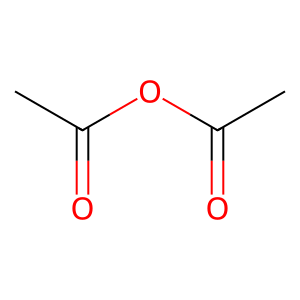 Cas:108-24-7

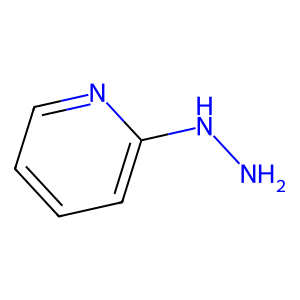 Cas:4930-98-7

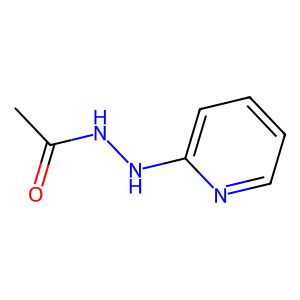 Cas:7707-99-5