
3-Methylbenzylamine
CAS No.:
100-81-2
M. Wt:
121.180
M. Fa:
C8H11N
InChI Key:
RGXUCUWVGKLACF-UHFFFAOYSA-N
Appearance:
Pale-yellow Liquid
Names and Identifiers of 3-Methylbenzylamine
CAS Number |
100-81-2 |
|---|---|
EC Number |
202-890-8 |
MDL Number |
MFCD00008118 |
IUPAC Name |
(3-methylphenyl)methanamine |
InChI |
InChI=1S/C8H11N/c1-7-3-2-4-8(5-7)6-9/h2-5H,6,9H2,1H3 |
InChIKey |
RGXUCUWVGKLACF-UHFFFAOYSA-N |
Canonical SMILES |
CC1=CC(=CC=C1)CN |
UNII |
JRQ2PCL7ZU |
UNSPSC Code |
12352100 |
Physical and chemical properties of 3-Methylbenzylamine
Acidity coefficient |
9.13±0.10(Predicted) |
|---|---|
Boiling Point |
200.2±9.0 °C at 760 mmHg |
BRN |
507474 |
Density |
1.0±0.1 g/cm3 |
Exact Mass |
121.089149 |
Flash Point |
80.6±0.0 °C |
Index of Refraction |
1.542 |
LogP |
1.55 |
Melting Point |
19.71°C (estimate) |
Molecular Formula |
C8H11N |
Molecular Weight |
121.180 |
PSA |
26.02000 |
Sensitivity |
Air Sensitive |
Storage condition |
Keep in dark place,Sealed in dry,Room Temperature |
Vapour Pressure |
0.3±0.4 mmHg at 25°C |
Safety Information of 3-Methylbenzylamine

Applications of 3-Methylbenzylamine
3-Methylbenzylamine finds applications in various fields:
- Chemical Synthesis: Used as an intermediate in the production of pharmaceuticals and agrochemicals.
- Catalysis: Acts as a catalyst in certain organic reactions.
- Polymer Chemistry: Utilized in the synthesis of polymeric materials due to its reactivity.
Interaction Studies of 3-Methylbenzylamine
Research on the interaction of 3-Methylbenzylamine with biological systems reveals:
- Receptor Binding: Studies are ongoing to understand its binding affinity to specific receptors in the central nervous system.
- Metabolic Pathways: Investigations into how this compound is metabolized in living organisms are crucial for assessing its safety and efficacy as a drug candidate.
Biological Activity of 3-Methylbenzylamine
3-Methylbenzylamine exhibits biological activity that may include:
- Neurotransmitter Activity: Some studies suggest that derivatives of 3-Methylbenzylamine may interact with neurotransmitter systems.
- Antimicrobial Properties: Preliminary research indicates potential antimicrobial effects against certain pathogens.
- Toxicity: The compound has been noted for its corrosive properties, which may lead to health risks upon exposure.
Physical sample testing spectrum (NMR) of 3-Methylbenzylamine

 Cas:57-13-6

 Cas:620-13-3

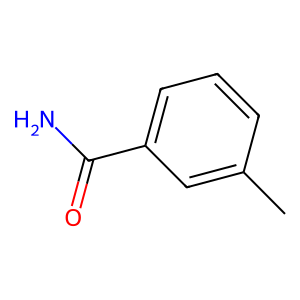 Cas:618-47-3
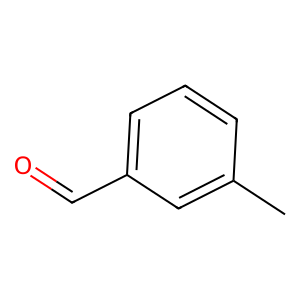 Cas:620-23-5