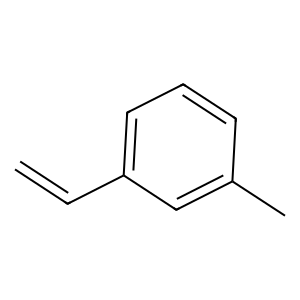
3-Methylstyrene
Names and Identifiers of 3-Methylstyrene
CAS Number |
100-80-1 |
|---|---|
EC Number |
202-889-2 |
IUPAC Name |
1-ethenyl-3-methylbenzene |
InChI |
InChI=1S/C9H10/c1-3-9-6-4-5-8(2)7-9/h3-7H,1H2,2H3 |
InChIKey |
JZHGRUMIRATHIU-UHFFFAOYSA-N |
Canonical SMILES |
CC1=CC(=CC=C1)C=C |
UNII |
FFK4I9430G |
Physical and chemical properties of 3-Methylstyrene
Boiling Point |
172 °C |
|---|---|
BRN |
1304618 |
Decomposition |
When heated to decomposition it emits acrid smoke and irritating vapors. |
Density |
Relative density (water = 1): 0.91 |
Exact Mass |
118.07800 |
Flash Point |
60 °C |
H Bond Acceptors |
0 |
H Bond Donors |
0 |
Index of Refraction |
Index of refraction: 1.5411 at 25 °C/D |
LogP |
3.580 |
Melting Point |
-86.3 °C |
Molecular Formula |
C9H10 |
Molecular Weight |
118.17600 |
Stability |
Stable under recommended storage conditions. Contains the following stabilizer(s): 3,5-Di-tert-butylpyrocatechol (0.1 %) |
Storage condition |
2-8°C |
Vapour density |
Relative vapor density (air = 1): 4.1 |
Vapour Pressure |
1.70 mm Hg at 25 °C |
Water Solubility |
Soluble in Methanol, Ether, Benzene, Acetone, Ethanol, Heptane. Soluble in water (0.09 g/L) at 20°C. |
Safety Information of 3-Methylstyrene


Applications of 3-Methylstyrene
3-Methylstyrene has a wide range of applications:
- Polymer Production: It serves as a key monomer in producing various copolymers and resins, enhancing material properties.
- Adhesives and Coatings: Its use in adhesives and coatings improves adhesion and durability.
- Chemical Intermediate: It acts as an intermediate in synthesizing pharmaceuticals and agrochemicals .
Interaction Studies of 3-Methylstyrene
Studies on the interaction of 3-methylstyrene with other compounds indicate potential synergistic effects when combined with certain solvents or catalysts. For instance, its interactions in supercritical carbon dioxide have been explored for improved extraction processes. Furthermore, research into its toxicity profile highlights interactions that may affect biological systems, necessitating further investigation into its environmental impact .
Biological Activity of 3-Methylstyrene
3-Methylstyrene exhibits notable biological effects. It is known to defat the skin, potentially leading to dryness or cracking upon prolonged exposure. Additionally, there are indications that it may affect liver function. Inhalation exposure has been associated with systemic effects, emphasizing the importance of safety measures when handling this compound .
Physical sample testing spectrum (NMR) of 3-Methylstyrene

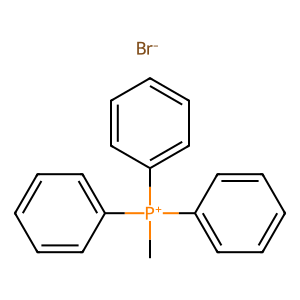 Cas:1779-49-3

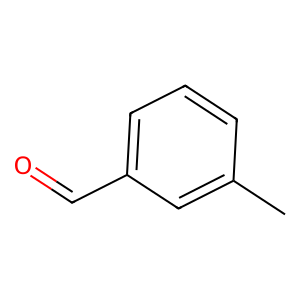 Cas:620-23-5

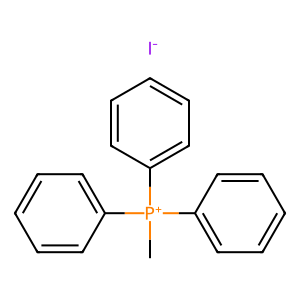 Cas:2065-66-9
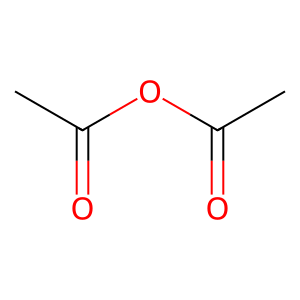 Cas:108-24-7