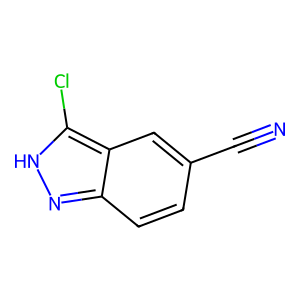
3-chloro-2H-indazole-5-carbonitrile
Names and Identifiers of 3-chloro-2H-indazole-5-carbonitrile
CAS Number |
1000341-16-1 |
|---|---|
IUPAC Name |
3-chloranyl-2H-indazole-5-carbonitrile |
Canonical SMILES |
C1=CC2=NNC(=C2C=C1C#N)Cl |
Physical and chemical properties of 3-chloro-2H-indazole-5-carbonitrile
Boiling Point |
403.0±25.0 °C at 760 mmHg |
|---|---|
Density |
1.5±0.1 g/cm3 |
Exact Mass |
177.009369 |
Flash Point |
197.5±23.2 °C |
Index of Refraction |
1.696 |
LogP |
2.15 |
Molecular Formula |
C8H4ClN3 |
Molecular Weight |
177.590 |
PSA |
52.47000 |
Vapour Pressure |
0.0±0.9 mmHg at 25°C |
Applications of 3-chloro-2H-indazole-5-carbonitrile
3-Chloro-1H-indazole-5-carbonitrile finds applications primarily in medicinal chemistry. Its derivatives are being explored for:
- Antiparasitic Drugs: Particularly against leishmaniasis.
- Anticancer Agents: Compounds derived from this structure are being tested for their efficacy against various cancer cell lines.
- Agrochemicals: Its reactivity makes it suitable for developing new pesticides or herbicides.
The compound's ability to serve as an intermediate in synthesizing more complex molecules further enhances its utility in pharmaceutical development.
Interaction Studies of 3-chloro-2H-indazole-5-carbonitrile
Studies have shown that 3-Chloro-1H-indazole-5-carbonitrile interacts with various biological targets, demonstrating potential as an inhibitor of specific enzymes involved in disease processes. For instance, it has been noted to affect pathways related to cancer cell proliferation and survival, making it a candidate for further investigation in drug development.
Biological Activity of 3-chloro-2H-indazole-5-carbonitrile
Research indicates that 3-Chloro-1H-indazole-5-carbonitrile exhibits notable biological activities. It has been evaluated for its potential as an antileishmanial agent, showing promising results in inhibiting the growth of Leishmania major, a parasite responsible for leishmaniasis. Furthermore, compounds with similar structures have been investigated for their anticancer properties and as inhibitors of various enzymes involved in disease pathways.