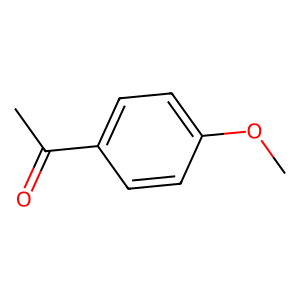
4'-Methoxyacetophenone
Names and Identifiers of 4'-Methoxyacetophenone
CAS Number |
100-06-1 |
|---|---|
EC Number |
202-815-9 |
MDL Number |
MFCD00008745 |
IUPAC Name |
1-(4-methoxyphenyl)ethanone |
InChI |
InChI=1S/C9H10O2/c1-7(10)8-3-5-9(11-2)6-4-8/h3-6H,1-2H3 |
InChIKey |
NTPLXRHDUXRPNE-UHFFFAOYSA-N |
Canonical SMILES |
CC(=O)C1=CC=C(C=C1)OC |
UNII |
0IRH2BR587 |
UNSPSC Code |
12352100 |
Physical and chemical properties of 4'-Methoxyacetophenone
Boiling Point |
152.00 to 154.00 °C. @ 26.00 mm Hg |
|---|---|
BRN |
742313 |
Decomposition |
When heated to decomposition it emits acrid smoke and irritating fumes. |
Density |
1.0818 g/cu cm at 41 °C |
Exact Mass |
150.068085 |
Flash Point |
138 °C (280 °F) - open cup |
Index of Refraction |
Index of refraction = 1.547 at 41 °C |
LogP |
1.74 |
Melting Point |
38 - 39 °C |
Molecular Formula |
C9H10O2 |
Molecular Weight |
150.174 |
Odor |
Similar to that of p-methylacetopheneone, suggestive of hawthorn and floral note of heliotrope |
PSA |
26.30000 |
Sensitivity |
Light Sensitive |
Solubility |
1.737g/L at 20°C in Water |
Stability |
Stable under recommended storage conditions. |
Storage condition |
Keep in dark place,Sealed in dry,Room Temperature |
Vapour Pressure |
6.44X10⁻³ mm Hg at 25 °C |
Water Solubility |
insoluble |
Solubility of 4'-Methoxyacetophenone
| Solvent | Dissolution Behavior | Temperature Effect | pH Effect |
|---|---|---|---|
| Water | Slightly soluble or nearly insoluble, forming turbidity or phase separation | Increased temperature slightly enhances solubility, but the effect is limited | pH changes have minimal impact on solubility in water |
| Ethanol | Readily soluble, forming a colorless transparent solution | Solubility increases with rising temperature; dissolves faster in hot ethanol | No significant pH effect (ethanol is a non-aqueous solvent) |
| Diethyl Ether | Soluble, good solubility | Increased temperature aids dissolution | No significant pH effect |
| Acetone | Readily soluble, dissolves rapidly to form a clear solution | Heating accelerates dissolution rate | No significant pH effect |
| Methanol | Readily soluble | Solubility increases with temperature | No significant pH effect |
| Chloroform | Soluble | Increased temperature slightly improves solubility | No significant pH effect |
| Benzene | Soluble | Solubility increases with rising temperature | No significant pH effect |
| Ethyl Acetate | Readily soluble | Heating promotes dissolution | No significant pH effect |
| n-Hexane | Slightly soluble or insoluble, may show partial miscibility | Solubility slightly improves at high temperatures | No pH effect (non-polar solvent) |
| Sodium Hydroxide Aqueous Solution (Basic) | Insoluble or possible hydrolysis, poor solubility | High temperature may promote hydrolysis rather than dissolution | Slow hydrolysis may occur under strong alkaline conditions, reducing stability |
| Hydrochloric Acid Aqueous Solution (Acidic) | Almost insoluble, no obvious reaction | Increased temperature shows no significant improvement | Relatively stable under strong acidic conditions, but solubility remains very low |
Safety Information of 4'-Methoxyacetophenone

Key Milestone of 4'-Methoxyacetophenone
| Time | Event | Description |
|---|---|---|
| Late 19th – Early 20th century | First Synthesis and Structural Confirmation | As an aromatic ketone, it was initially synthesized during the early development of organic chemistry. Its structure was confirmed using classical organic analytical methods (such as elemental analysis and derivative preparation), identifying it as a methoxy-substituted derivative of acetophenone. |
| 1920s–1940s | Preliminary Application in the Fragrance Industry | Due to its mild aroma resembling hawthorn, cherry, or floral notes, it began to be used as an intermediate in synthetic fragrances, formulated into both perfumery and flavoring agents. |
| 1950s–1960s | Establishment as an Organic Synthesis Intermediate | Widely employed in the synthesis of pharmaceuticals and fine chemicals; for example, as a precursor in synthesizing analogs of paracetamol (acetaminophen), antihistamines, and plant growth regulators. The methoxy and acetyl functional groups allow easy further transformations (e.g., reduction, condensation, halogenation). |
| 1970s–1980s | Research in Photochemistry and Photosensitive Materials | Found to exhibit photosensitive properties, it was studied in photo-induced reactions and served as a model compound for investigating photoinitiators or photocrosslinking systems. |
| 1990s–2000s | Key Intermediate in Natural Product Synthesis | Used as an important building block in the synthesis of bioactive natural products (such as flavonoids and chalcones), enabling the construction of aromatic ring frameworks. |
| 2000s–Present | Drug Development and Biological Activity Exploration | Employed as a structural scaffold for designing novel anti-inflammatory, antioxidant, and anticancer compounds. Some derivatives have shown promising pharmacological activities, driving continued applications in medicinal chemistry. |
| 2010s–Present | Green Synthesis and Process Optimization | Development of more environmentally friendly synthetic routes (e.g., catalytic oxidation, microwave-assisted synthesis, biocatalysis) to improve yield and reduce byproducts, meeting the demands of sustainable industrial development. |
Applications of 4'-Methoxyacetophenone
4'-Methoxyacetophenone finds applications across various fields:
- Fragrance Industry: Its sweet and aromatic scent makes it valuable in perfumes and flavoring agents.
- Pharmaceuticals: The compound serves as an intermediate in the synthesis of various pharmaceuticals and agrochemicals.
- Chemical Research: It is utilized as a standard substrate in organic synthesis and chemical research due to its reactivity and stability.
Interaction Studies of 4'-Methoxyacetophenone
Studies have explored the interactions of 4'-methoxyacetophenone with various biological systems. For instance, its interaction with enzymes involved in metabolic pathways has been investigated to understand its potential therapeutic effects. Additionally, research into its binding affinity with specific receptors may provide insights into its biological mechanisms.
Biological Activity of 4'-Methoxyacetophenone
Research indicates that 4'-methoxyacetophenone exhibits several biological activities. It has been noted for its potential antimicrobial properties, making it a candidate for further exploration in pharmacological applications. Additionally, its derivatives may possess anti-inflammatory and analgesic effects, although more extensive studies are required to fully elucidate these properties.
 Cas:100-09-4

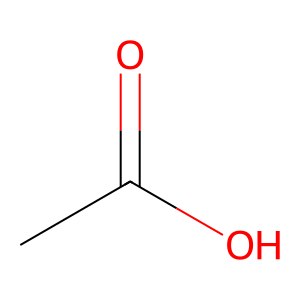 Cas:64-19-7

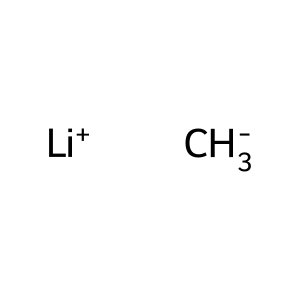 Cas:917-54-4