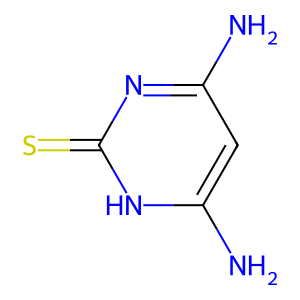
4,6-Diamino-2-mercaptopyrimidine
CAS No.:
1004-39-3
M. Wt:
142.182
M. Fa:
C4H6N4S
InChI Key:
QCAWOHUJKPKOMD-UHFFFAOYSA-N
Appearance:
Yellow Solid
Names and Identifiers of 4,6-Diamino-2-mercaptopyrimidine
CAS Number |
1004-39-3 |
|---|---|
EC Number |
213-721-2 |
MDL Number |
MFCD00006078 |
IUPAC Name |
4,6-diamino-1H-pyrimidine-2-thione |
InChI |
InChI=1S/C4H6N4S/c5-2-1-3(6)8-4(9)7-2/h1H,(H5,5,6,7,8,9) |
InChIKey |
QCAWOHUJKPKOMD-UHFFFAOYSA-N |
Canonical SMILES |
C1=C(NC(=S)N=C1N)N |
UNII |
0VP6I0FY3O |
UNSPSC Code |
12352100 |
Physical and chemical properties of 4,6-Diamino-2-mercaptopyrimidine
Acidity coefficient |
11.81±0.10(Predicted) |
|---|---|
Boiling Point |
464.4±48.0 °C at 760 mmHg |
BRN |
124937 |
Density |
1.5±0.1 g/cm3 |
Exact Mass |
142.031311 |
Flash Point |
234.7±29.6 °C |
Index of Refraction |
1.781 |
LogP |
-3.63 |
Melting Point |
>300 °C(lit.) |
Molecular Formula |
C4H6N4S |
Molecular Weight |
142.182 |
PSA |
116.62000 |
Solubility |
1 M NaOH: soluble2% |
Stability |
Hygroscopic |
Storage condition |
Store below +30°C. |
Vapour Pressure |
0.0±1.1 mmHg at 25°C |
Safety Information of 4,6-Diamino-2-mercaptopyrimidine

Applications of 4,6-Diamino-2-mercaptopyrimidine
4,6-Diamino-2-mercaptopyrimidine finds applications across various fields:
- Catalysis: It is used in the synthesis of coordination polymers that exhibit catalytic properties for organic reactions, such as the Hantzsch synthesis of polyhydroquinolines.
- Corrosion Inhibition: Its ability to inhibit copper corrosion makes it valuable in materials science and engineering applications.
- Metal Chelation: As a chelating agent, it plays a crucial role in forming stable complexes with transition metals, enhancing their solubility and reactivity in various chemical processes.
Interaction Studies of 4,6-Diamino-2-mercaptopyrimidine
Studies have focused on the interaction of 4,6-diamino-2-mercaptopyrimidine with metals and other compounds:
- Copper Interaction: Investigations into its role as a corrosion inhibitor have highlighted how it interacts with copper ions in saline solutions, providing insights into its protective mechanisms against corrosion.
- Coordination Complexes: Research into its coordination behavior with silver and nickel has revealed details about the structural characteristics of formed complexes, including stability and reusability in catalytic applications.
Biological Activity of 4,6-Diamino-2-mercaptopyrimidine
Research indicates that 4,6-diamino-2-mercaptopyrimidine exhibits notable biological activity. It has been studied for its potential as a corrosion inhibitor for copper in saline environments, where it demonstrated effective inhibition through both experimental and theoretical studies. Additionally, its chelating properties may contribute to biological applications related to metal ion transport and detoxification.
Physical sample testing spectrum (NMR) of 4,6-Diamino-2-mercaptopyrimidine

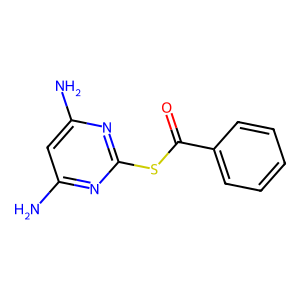 Cas:65349-39-5

 Cas:109-77-3

 Cas:141-52-6
 Cas:17356-08-0