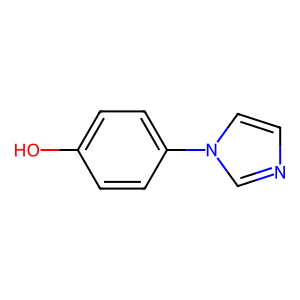
4-(1h-Imidazol-1-yl)phenol
Names and Identifiers of 4-(1h-Imidazol-1-yl)phenol
CAS Number |
10041-02-8 |
|---|---|
EC Number |
233-121-4 |
MDL Number |
MFCD00005281 |
IUPAC Name |
4-imidazol-1-ylphenol |
InChI |
InChI=1S/C9H8N2O/c12-9-3-1-8(2-4-9)11-6-5-10-7-11/h1-7,12H |
InChIKey |
CYKCUAPYWQDIKR-UHFFFAOYSA-N |
Canonical SMILES |
C1=CC(=CC=C1N2C=CN=C2)O |
UNSPSC Code |
12352100 |
Physical and chemical properties of 4-(1h-Imidazol-1-yl)phenol
Acidity coefficient |
9.36±0.26(Predicted) |
|---|---|
Boiling Point |
350.7ºC at 760 mmHg |
BRN |
509999 |
Density |
1.2 g/cm3 |
Exact Mass |
160.06400 |
Flash Point |
165.9ºC |
Index of Refraction |
1.62 |
LogP |
1.57790 |
Melting Point |
204-206 °C(lit.) |
Molecular Formula |
C9H8N2O |
Molecular Weight |
160.17300 |
PSA |
38.05000 |
Storage condition |
Inert atmosphere,Room Temperature |
Vapour Pressure |
2.14E-05mmHg at 25°C |
Safety Information of 4-(1h-Imidazol-1-yl)phenol

Applications of 4-(1h-Imidazol-1-yl)phenol
4-(Imidazol-1-yl)phenol finds applications across various fields:
- Pharmaceutical Research: As a potential therapeutic agent due to its biological activity.
- Chemical Analysis: Used as a signal enhancer in chemiluminescence immunoassays, particularly involving horseradish peroxidase.
- Material Science: Its ability to form complexes with metals makes it useful in developing new materials with tailored properties.
Interaction Studies of 4-(1h-Imidazol-1-yl)phenol
Interaction studies have demonstrated that 4-(Imidazol-1-yl)phenol can interact with various biological molecules, influencing their activity. For example, it has been shown to mediate cysteine S-nitrosylation of target proteins involved in inflammatory responses. Additionally, its interactions with transition metals can modify its electronic properties and enhance its efficacy as a drug candidate.
Biological Activity of 4-(1h-Imidazol-1-yl)phenol
4-(Imidazol-1-yl)phenol has been studied for its biological activities, particularly as an inhibitor in various biochemical pathways. It is known to produce nitric oxide, a critical signaling molecule involved in numerous physiological processes, including inflammation and immune response. The compound has shown potential in enhancing pro-inflammatory mediators such as interleukin 6 and interleukin 8, indicating its role in inflammatory responses.
Moreover, studies have suggested that 4-(Imidazol-1-yl)phenol may exhibit antimicrobial properties and could be useful in developing therapeutic agents against certain pathogens.
Physical sample testing spectrum (NMR) of 4-(1h-Imidazol-1-yl)phenol

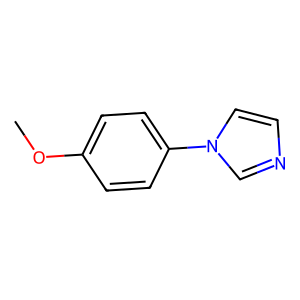 Cas:10040-95-6

 Cas:288-32-4

 Cas:540-38-5
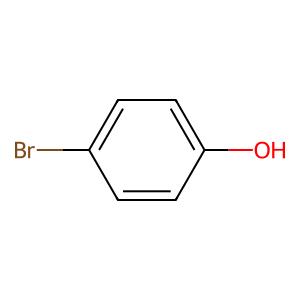 Cas:106-41-2