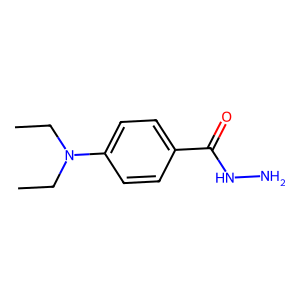
4-(Diethylamino)benzohydrazide
Names and Identifiers of 4-(Diethylamino)benzohydrazide
CAS Number |
100139-54-6 |
|---|---|
EC Number |
674-299-7 |
MDL Number |
MFCD01310809 |
IUPAC Name |
4-(diethylamino)benzohydrazide |
InChI |
InChI=1S/C11H17N3O/c1-3-14(4-2)10-7-5-9(6-8-10)11(15)13-12/h5-8H,3-4,12H2,1-2H3,(H,13,15) |
InChIKey |
PUNSOBLTEWFAMJ-UHFFFAOYSA-N |
Canonical SMILES |
CCN(CC)C1=CC=C(C=C1)C(=O)NN |
UNSPSC Code |
12352100 |
Physical and chemical properties of 4-(Diethylamino)benzohydrazide
BRN |
2731205 |
|---|---|
Density |
1.102g/cm3 |
Exact Mass |
207.13700 |
Index of Refraction |
1.577 |
LogP |
2.22750 |
Melting Point |
99-101ºC |
Molecular Formula |
C11H17N3O |
Molecular Weight |
207.27200 |
PSA |
58.36000 |
Solubility |
29.5 [ug/mL] (The mean of the results at pH 7.4) |
Storage condition |
Keep in dark place,Sealed in dry,2-8°C |
Safety Information of 4-(Diethylamino)benzohydrazide


Applications of 4-(Diethylamino)benzohydrazide
4-(Diethylamino)benzohydrazide finds applications across various fields:
- Pharmaceuticals: It serves as a precursor for synthesizing bioactive compounds with potential therapeutic effects.
- Agricultural Chemistry: Its derivatives may be explored for use as agrochemicals due to their biological activities.
- Material Science: The compound can be utilized in developing new materials with specific properties based on its chemical structure.
Interaction Studies of 4-(Diethylamino)benzohydrazide
Interaction studies have revealed that 4-(Diethylamino)benzohydrazide interacts significantly with proteins involved in cellular signaling pathways. For example, its binding affinity to MARK4 has been characterized through fluorescence quenching methods, indicating strong interactions that could be exploited for drug design. Additionally, studies on its interactions with human serum albumin suggest its potential bioavailability and distribution within biological systems.
Biological Activity of 4-(Diethylamino)benzohydrazide
Research indicates that 4-(Diethylamino)benzohydrazide exhibits notable biological activities, particularly in enzyme inhibition. For instance, studies have shown its potential to inhibit MARK4 (Microtubule Affinity Regulating Kinase 4), impacting cellular processes related to phosphorylation of tau proteins. This inhibition suggests its potential role in neurodegenerative diseases where tau phosphorylation is a key factor.
Additionally, compounds with similar structures have been evaluated for their antimicrobial and anticancer properties, indicating that 4-(Diethylamino)benzohydrazide may also possess such activities.
Physical sample testing spectrum (NMR) of 4-(Diethylamino)benzohydrazide

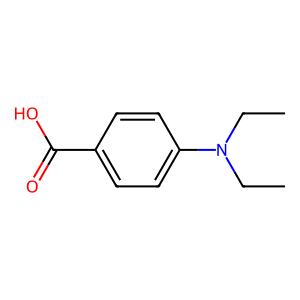 Cas:5429-28-7

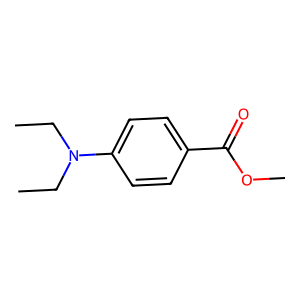 Cas:91563-80-3
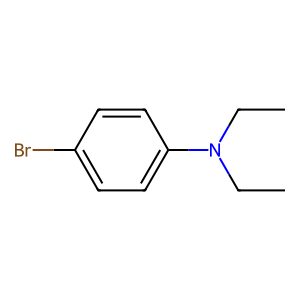 Cas:2052-06-4