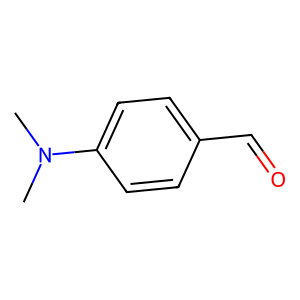
4-(Dimethylamino)benzaldehyde
CAS No.:
100-10-7
M. Wt:
149.190
M. Fa:
C9H11NO
InChI Key:
BGNGWHSBYQYVRX-UHFFFAOYSA-N
Appearance:
Blue Solid
Names and Identifiers of 4-(Dimethylamino)benzaldehyde
CAS Number |
100-10-7 |
|---|---|
EC Number |
202-819-0 |
MDL Number |
MFCD00003381 |
IUPAC Name |
4-(dimethylamino)benzaldehyde |
InChI |
InChI=1S/C9H11NO/c1-10(2)9-5-3-8(7-11)4-6-9/h3-7H,1-2H3 |
InChIKey |
BGNGWHSBYQYVRX-UHFFFAOYSA-N |
Canonical SMILES |
CN(C)C1=CC=C(C=C1)C=O |
UNII |
V7E88PR1YB |
UNSPSC Code |
12352100 |
Physical and chemical properties of 4-(Dimethylamino)benzaldehyde
Acidity coefficient |
pK1:1.647(+1) (25°C) |
|---|---|
Boiling Point |
176-177 ºC (17 mmHg) |
BRN |
606802 |
Density |
1.1±0.1 g/cm3 |
Exact Mass |
149.084061 |
Flash Point |
164 ºC |
Index of Refraction |
1.596 |
LogP |
1.81 |
Melting Point |
72-75 °C(lit.) |
Merck |
14,3230 |
Molecular Formula |
C9H11NO |
Molecular Weight |
149.190 |
Odor |
Characteristic odor |
PSA |
20.31000 |
Sensitivity |
Air Sensitive |
Solubility |
alcohol: passes test (APHA ≤60) |
Stability |
Stable, but light sensitive. Incompatible with bases, strong oxidizing agents. |
Storage condition |
2-8°C |
Vapour Pressure |
0.0±0.5 mmHg at 25°C |
Water Solubility |
0.3 g/L (20 ºC) |
Solubility of 4-(Dimethylamino)benzaldehyde
| Solvent | Dissolution Phenomenon | Temperature Effect | pH Effect |
|---|---|---|---|
| Water | Slightly soluble or nearly insoluble | Solubility improves slightly with increasing temperature, but remains very low | Possible protonation under acidic conditions, slightly increased solubility; may form salts in strong acids, enhancing solubility; stable in alkaline conditions but water solubility does not significantly increase |
| Ethanol | Readily soluble, forming a colorless to light yellow solution | Solubility increases with rising temperature | Minimal pH effect, but condensation reactions (e.g., with amines) may occur in strongly acidic conditions, indirectly affecting stability |
| Methanol | Readily soluble | Increased temperature promotes dissolution | Similar to ethanol; side reactions may occur under strongly acidic conditions |
| Acetone | Soluble | Solubility increases with rising temperature | Generally unaffected by pH (non-aqueous system); however, in aqueous mixtures, reaction activity should be considered under acidic conditions |
| Ether | Slightly to moderately soluble | Increased temperature aids dissolution | Almost no direct effect, as ether is an inert solvent |
| Chloroform | Readily soluble | Exhibits good solubility at elevated temperatures | No pH effect (non-aqueous protic environment) |
| Ethyl Acetate | Moderately soluble | Solubility increases with rising temperature | Minimal effect, but long-term storage in acidic or basic conditions may lead to decomposition |
| Benzene | Soluble | Heating enhances dissolution | Essentially unaffected |
| Dimethyl Sulfoxide (DMSO) | Highly soluble, commonly used for preparing stock solutions | Rapidly dissolves at room temperature; heating is not significantly necessary | Stable, compatible with a wide pH range, suitable for biochemical experiments |
| Tetrahydrofuran (THF) | Soluble | Complete dissolution upon heating | Sensitive to moisture and acid; strong acidic conditions should be avoided |
Safety Information of 4-(Dimethylamino)benzaldehyde


Key Milestone of 4-(Dimethylamino)benzaldehyde
| Time | Event | Background/Significance |
|---|---|---|
| 1870s | First synthesis | Synthesized by German chemists during research on aromatic aldehyde derivatives, representing one of the early achievements in the exploration of substituted aromatic aldehydes. |
| 1880s–1890s | Application as dye intermediate | Used in the synthesis of triarylmethane and azo dyes. Its strong electron-donating dimethylamino group enhances the conjugated chromophore system, improving dye color intensity. |
| 1920s | Development of Ehrlich reagent | The Ehrlich reagent containing DMAB (in acidic solution) was developed for detecting indole compounds (such as urobilinogen in urine), becoming an important tool in clinical and biochemical analysis. |
| 1930s–1940s | Expanded applications in pharmaceutical synthesis | Served as a key intermediate in synthesizing antimalarial drugs (e.g., precursors of chloroguanide) and local anesthetics, enhancing its importance in the pharmaceutical industry. |
| 1950s | Detection of tryptophan and proteins | DMAB became a standard reagent for detecting indole derivatives such as tryptophan and serotonin, widely used in biochemistry and clinical diagnostics. |
| 1960s–1970s | Development of fluorescent probes and chromogenic agents | Leveraged its property of producing colored or fluorescent products when reacting with amines or aldehydes, becoming a chromogenic agent for thin-layer chromatography (TLC), used in detecting alkaloids, amino acids, and more. |
| 1980s–1990s | Exploration in materials science | Used as an organic synthesis building block for preparing nonlinear optical materials, liquid crystal molecules, and photosensitive polymers, expanding its applications in functional materials. |
| 2000s–present | Ongoing applications across multiple fields and green synthesis research | Widely used in pharmaceutical intermediates, diagnostic reagents, and food safety testing (e.g., screening for illegal additives); research also focuses on greener synthesis methods (e.g., catalytic oxidation) to reduce environmental impact. |
Applications of 4-(Dimethylamino)benzaldehyde
4-(Dimethylamino)benzaldehyde has diverse applications across various fields:
- Analytical Chemistry: Primarily used as a reagent in colorimetric assays for detecting indoles and other nitrogen-containing compounds.
- Dye Manufacturing: Utilized in synthesizing azo dyes and other colorants due to its reactive aldehyde group.
- Pharmaceuticals: Serves as an intermediate in pharmaceutical synthesis.
Interaction Studies of 4-(Dimethylamino)benzaldehyde
Research has focused on the interactions of 4-(dimethylamino)benzaldehyde with various biomolecules, particularly its role as an electrophile. Studies indicate that it can modify proteins and nucleic acids through its reactive carbonyl group, leading to potential applications in drug development and biochemical assays.
Biological Activity of 4-(Dimethylamino)benzaldehyde
4-(Dimethylamino)benzaldehyde exhibits notable biological activity, particularly in analytical biochemistry. It is used in:
- Detection of Indole Alkaloids: Its reaction with indoles allows for the qualitative analysis of these compounds in various biological samples.
- Porphobilinogen Detection: It reacts with porphobilinogen to produce a distinct pink compound, aiding in diagnosing certain metabolic disorders.
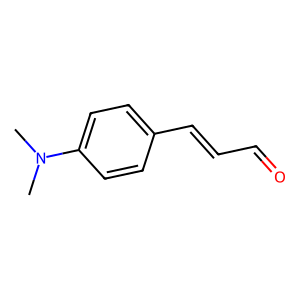 Cas:6203-18-5

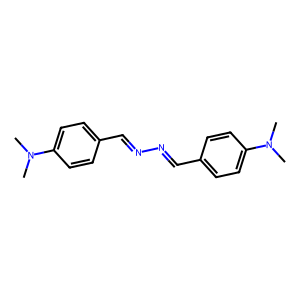 Cas:2143-98-8
 Cas:2929-84-2