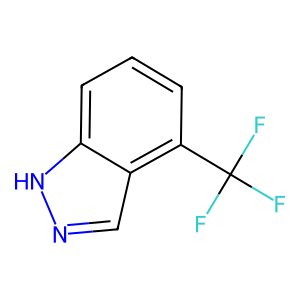
4-(Trifluoromethyl)-1H-indazole
CAS No.:
1000339-98-9
M. Wt:
186.134
M. Fa:
C8H5F3N2
InChI Key:
KCWIWQGNCLKDJZ-UHFFFAOYSA-N
Appearance:
Pale-yellow Solid
Names and Identifiers of 4-(Trifluoromethyl)-1H-indazole
CAS Number |
1000339-98-9 |
|---|---|
MDL Number |
MFCD09263211 |
IUPAC Name |
4-(trifluoromethyl)-1H-indazole |
InChI |
InChI=1S/C8H5F3N2/c9-8(10,11)6-2-1-3-7-5(6)4-12-13-7/h1-4H,(H,12,13) |
InChIKey |
KCWIWQGNCLKDJZ-UHFFFAOYSA-N |
Canonical SMILES |
C1=CC(=C2C=NNC2=C1)C(F)(F)F |
UNSPSC Code |
12352100 |
Physical and chemical properties of 4-(Trifluoromethyl)-1H-indazole
Acidity coefficient |
12.15±0.40(Predicted) |
|---|---|
Boiling Point |
268.5±35.0 °C at 760 mmHg |
Density |
1.4±0.1 g/cm3 |
Exact Mass |
186.040482 |
Flash Point |
116.2±25.9 °C |
Index of Refraction |
1.560 |
LogP |
2.39 |
Molecular Formula |
C8H5F3N2 |
Molecular Weight |
186.134 |
PSA |
28.68000 |
Storage condition |
2-8°C |
Vapour Pressure |
0.0±0.5 mmHg at 25°C |
Safety Information of 4-(Trifluoromethyl)-1H-indazole

Applications of 4-(Trifluoromethyl)-1H-indazole
4-(Trifluoromethyl)-1H-indazole has various applications across multiple domains:
- Pharmaceuticals: It serves as a building block for developing new drugs with improved efficacy and stability.
- Agrochemicals: The compound is investigated for use in crop protection products due to its biological activity against pests and pathogens.
- Material Science: Its unique properties make it suitable for developing advanced materials with specific functional characteristics.
Interaction Studies of 4-(Trifluoromethyl)-1H-indazole
Interaction studies have shown that 4-(Trifluoromethyl)-1H-indazole can interact with various biological targets:
- Enzyme Inhibition: It has been identified as a potential inhibitor of cytochrome P450 enzymes, impacting drug metabolism.
- Protein Binding: The lipophilicity conferred by the trifluoromethyl group enhances its ability to bind to proteins, influencing its pharmacokinetics and pharmacodynamics.
Biological Activity of 4-(Trifluoromethyl)-1H-indazole
The biological activity of 4-(Trifluoromethyl)-1H-indazole is influenced by its trifluoromethyl group, which enhances metabolic stability and lipophilicity. This compound has been studied for its potential pharmacological effects, including:
- Antimicrobial Properties: Some derivatives exhibit significant antimicrobial activity.
- Anticancer Activity: Research indicates that certain indazole derivatives can inhibit tumor growth and induce apoptosis in cancer cells.
- CYP Enzyme Inhibition: The compound has shown potential as an inhibitor of specific cytochrome P450 enzymes, which are crucial in drug metabolism.
Physical sample testing spectrum (NMR) of 4-(Trifluoromethyl)-1H-indazole
