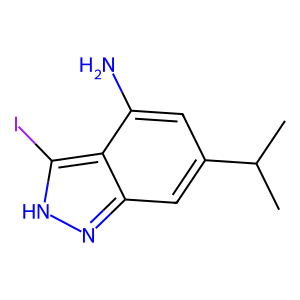
4-AMINO-3-IODO-6-ISOPROPYL (1H)INDAZOLE
Names and Identifiers of 4-AMINO-3-IODO-6-ISOPROPYL (1H)INDAZOLE
CAS Number |
1000341-03-6 |
|---|---|
IUPAC Name |
3-iodanyl-6-propan-2-yl-2H-indazol-4-amine |
Canonical SMILES |
CC(C)C1=CC2=NNC(=C2C(=C1)N)I |
Physical and chemical properties of 4-AMINO-3-IODO-6-ISOPROPYL (1H)INDAZOLE
Boiling Point |
443.7±40.0 °C at 760 mmHg |
|---|---|
Density |
1.8±0.1 g/cm3 |
Exact Mass |
301.007568 |
Flash Point |
222.2±27.3 °C |
Index of Refraction |
1.734 |
LogP |
3.21 |
Molecular Formula |
C10H12IN3 |
Molecular Weight |
301.127 |
Vapour Pressure |
0.0±1.1 mmHg at 25°C |
Applications of 4-AMINO-3-IODO-6-ISOPROPYL (1H)INDAZOLE
4-Amino-3-iodo-6-isopropyl-1H-indazole has potential applications in pharmaceutical research due to its biological activity. It may serve as a lead compound for developing new drugs targeting cannabinoid receptors or as a scaffold for synthesizing other biologically active molecules. Its unique structure makes it valuable in medicinal chemistry for exploring novel therapeutic agents.
Interaction Studies of 4-AMINO-3-IODO-6-ISOPROPYL (1H)INDAZOLE
Studies on the interactions of 4-amino-3-iodo-6-isopropyl-1H-indazole with biological targets are essential for understanding its pharmacological profile. Preliminary investigations suggest that it may interact with cannabinoid receptors and could modulate their activity. Further research is needed to elucidate its binding affinities and mechanisms of action at the molecular level.
Biological Activity of 4-AMINO-3-IODO-6-ISOPROPYL (1H)INDAZOLE
Research indicates that 4-amino-3-iodo-6-isopropyl-1H-indazole exhibits promising biological activities. It has been studied for its potential effects on cannabinoid receptors, particularly the CB1 receptor, which is implicated in various physiological processes including appetite regulation and pain sensation. Furthermore, compounds with similar indazole structures have shown cytotoxic effects against certain cancer cell lines, suggesting that this compound may also possess anti-cancer properties.