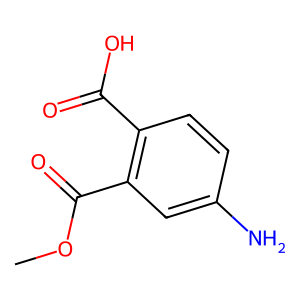
4-Amino-2-(methoxycarbonyl)benzoic acid
Names and Identifiers of 4-Amino-2-(methoxycarbonyl)benzoic acid
CAS Number |
1000342-08-4 |
|---|---|
IUPAC Name |
4-amino-2-methoxycarbonylbenzoic acid |
InChI |
InChI=1S/C9H9NO4/c1-14-9(13)7-4-5(10)2-3-6(7)8(11)12/h2-4H,10H2,1H3,(H,11,12) |
InChIKey |
QYIMVQNDYUAYTM-UHFFFAOYSA-N |
Canonical SMILES |
COC(=O)C1=C(C=CC(=C1)N)C(=O)O |
Physical and chemical properties of 4-Amino-2-(methoxycarbonyl)benzoic acid
Boiling Point |
418.4±35.0 °C at 760 mmHg |
|---|---|
Density |
1.4±0.1 g/cm3 |
Exact Mass |
195.053162 |
Flash Point |
206.8±25.9 °C |
Index of Refraction |
1.609 |
LogP |
0.17 |
Molecular Formula |
C9H9NO4 |
Molecular Weight |
195.172 |
Vapour Pressure |
0.0±1.0 mmHg at 25°C |
Applications of 4-Amino-2-(methoxycarbonyl)benzoic acid
4-Amino-2-(methoxycarbonyl)benzoic acid has diverse applications:
- Organic Synthesis: It serves as a building block for more complex organic molecules.
- Pharmaceuticals: Investigated for its potential use in drug development and as an intermediate in pharmaceutical synthesis.
- Dyes and Pigments: Employed in producing various dyes and pigments due to its chemical properties.
Interaction Studies of 4-Amino-2-(methoxycarbonyl)benzoic acid
The mechanism of action for 4-Amino-2-(methoxycarbonyl)benzoic acid involves interactions with specific molecular targets. The amino group can form hydrogen bonds with biological molecules, influencing their functionality. Additionally, the methoxycarbonyl group can participate in esterification reactions, further modifying the compound's reactivity and interaction profile.
Biological Activity of 4-Amino-2-(methoxycarbonyl)benzoic acid
Research indicates that 4-Amino-2-(methoxycarbonyl)benzoic acid exhibits biological activity that may be relevant in pharmacology. It serves as a precursor in synthesizing biologically active compounds, suggesting potential medicinal applications. Its ability to form hydrogen bonds through the amino group allows it to interact with various biological targets, influencing their activity. Studies are ongoing to explore its role in drug development and other therapeutic applications.