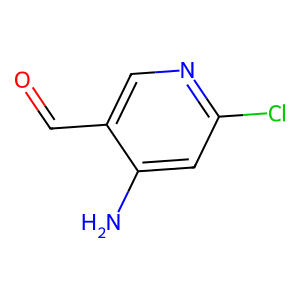
4-Amino-6-chloronicotinaldehyde
Names and Identifiers of 4-Amino-6-chloronicotinaldehyde
CAS Number |
1001756-21-3 |
|---|---|
EC Number |
849-093-7 |
MDL Number |
MFCD09834660 |
IUPAC Name |
4-amino-6-chloropyridine-3-carbaldehyde |
InChI |
InChI=1S/C6H5ClN2O/c7-6-1-5(8)4(3-10)2-9-6/h1-3H,(H2,8,9) |
InChIKey |
CGMIFAMRODWNJB-UHFFFAOYSA-N |
Canonical SMILES |
C1=C(C(=CN=C1Cl)C=O)N |
UNSPSC Code |
12352100 |
Physical and chemical properties of 4-Amino-6-chloronicotinaldehyde
Acidity coefficient |
2.58±0.42(Predicted) |
|---|---|
Boiling Point |
379.0±42.0 °C at 760 mmHg |
Density |
1.4±0.1 g/cm3 |
Exact Mass |
156.009033 |
Flash Point |
183.0±27.9 °C |
Index of Refraction |
1.663 |
LogP |
1.98 |
Molecular Formula |
C6H5ClN2O |
Molecular Weight |
156.570 |
PSA |
55.98000 |
Storage condition |
under inert gas (nitrogen or Argon) at 2–8 °C |
Vapour Pressure |
0.0±0.9 mmHg at 25°C |
Safety Information of 4-Amino-6-chloronicotinaldehyde

Applications of 4-Amino-6-chloronicotinaldehyde
4-Amino-6-chloronicotinaldehyde has several applications across various fields:
- Organic Synthesis: It serves as an intermediate in synthesizing more complex organic molecules.
- Pharmaceutical Chemistry: It is used in developing biologically active compounds, particularly those targeting specific enzymes or receptors.
- Material Science: The compound can be utilized in producing specialty chemicals and materials due to its reactive functional groups.
Interaction Studies of 4-Amino-6-chloronicotinaldehyde
Interaction studies involving 4-Amino-6-chloronicotinaldehyde focus on its reactivity with biological macromolecules such as proteins and nucleic acids. Findings suggest that it may form adducts with amino acids or nucleobases, potentially influencing biological functions. Further research is required to elucidate these interactions and their implications for drug design and development.
Similar Compounds: ComparisonSeveral compounds share structural similarities with 4-Amino-6-chloronicotinaldehyde, each exhibiting unique features:
| Compound Name | Structure Type | Unique Features |
|---|---|---|
| 4-Amino-6-methoxynicotinaldehyde | Methoxy derivative | Contains a methoxy group instead of chlorine |
| 6-Chloronicotinaldehyde | Chlorinated derivative | Lacks the amino group at the 4-position |
| 4-Amino-3-chloronicotinaldehyde | Position isomer | Amino group at the 3-position instead of the 4-position |
| 4-Amino-5-bromonicotinaldehyde | Brominated derivative | Contains bromine, affecting electronic properties |
Biological Activity of 4-Amino-6-chloronicotinaldehyde
Research indicates that 4-Amino-6-chloronicotinaldehyde exhibits potential biological activities. Its unique structure allows it to interact with various biological targets, including enzymes and receptors. The amino and aldehyde groups facilitate hydrogen bonding and covalent interactions, which may influence biochemical pathways. Preliminary studies suggest potential applications in medicinal chemistry, particularly in developing compounds with antimicrobial and anticancer properties.
Physical sample testing spectrum (NMR) of 4-Amino-6-chloronicotinaldehyde

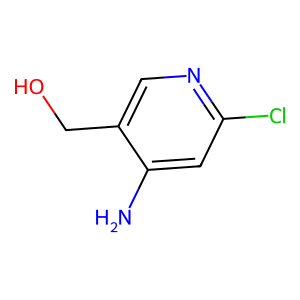 Cas:846036-96-2
