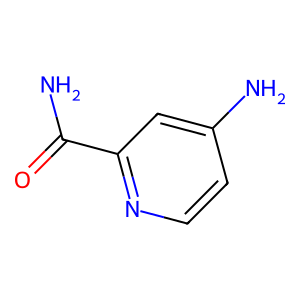
4-Aminopicolinamide
Names and Identifiers of 4-Aminopicolinamide
CAS Number |
100137-47-1 |
|---|---|
EC Number |
843-042-2 |
MDL Number |
MFCD08062892 |
IUPAC Name |
4-aminopyridine-2-carboxamide |
InChI |
InChI=1S/C6H7N3O/c7-4-1-2-9-5(3-4)6(8)10/h1-3H,(H2,7,9)(H2,8,10) |
InChIKey |
QKNCZYUYGMWQPB-UHFFFAOYSA-N |
Canonical SMILES |
C1=CN=C(C=C1N)C(=O)N |
UNSPSC Code |
12352100 |
Physical and chemical properties of 4-Aminopicolinamide
Acidity coefficient |
15.33±0.50(Predicted) |
|---|---|
Boiling Point |
413.0±30.0 °C(Predicted) |
Density |
1.323±0.06 g/cm3(Predicted) |
Exact Mass |
137.05900 |
LogP |
1.04420 |
Melting Point |
169 °C |
Molecular Formula |
C6H7N3O |
Molecular Weight |
137.13900 |
PSA |
82.00000 |
Storage condition |
Keep in dark place,Inert atmosphere,Room temperature |
Safety Information of 4-Aminopicolinamide

Applications of 4-Aminopicolinamide
4-Aminopicolinamide has several applications across different fields:
- Pharmaceuticals: It is explored as a scaffold for developing new antifungal agents and other therapeutic compounds due to its biological activity.
- Organic Synthesis: Its ability to participate in cross-coupling reactions makes it valuable for synthesizing complex organic molecules.
- Catalysis: The compound's unique properties allow it to serve as a ligand in catalysis, enhancing reaction efficiency and selectivity.
Interaction Studies of 4-Aminopicolinamide
Interaction studies involving 4-Aminopicolinamide focus on its binding affinity to various biological targets. Notably, research has identified its interaction with Sec14p, elucidating the mechanism by which it inhibits fungal growth. This understanding aids in optimizing the compound's structure for enhanced efficacy against fungal infections. Furthermore, studies have explored its interactions with metal ions, which may enhance its catalytic properties.
Biological Activity of 4-Aminopicolinamide
4-Aminopicolinamide exhibits significant biological activity, particularly as an antifungal agent. Research indicates that compounds containing the picolinamide scaffold can inhibit key proteins involved in fungal metabolism, such as Sec14p in Saccharomyces cerevisiae. This inhibition is crucial for developing new antifungal therapies, especially against resistant strains. Additionally, its derivatives have shown promise in targeting other biological pathways, potentially leading to novel therapeutic applications.
Physical sample testing spectrum (NMR) of 4-Aminopicolinamide
