
4-Aminopyridine-2-carboxylic acid
Names and Identifiers of 4-Aminopyridine-2-carboxylic acid
CAS Number |
100047-36-7 |
|---|---|
EC Number |
687-925-9 |
MDL Number |
MFCD02685671 |
IUPAC Name |
4-aminopyridine-2-carboxylic acid |
InChI |
InChI=1S/C6H6N2O2/c7-4-1-2-8-5(3-4)6(9)10/h1-3H,(H2,7,8)(H,9,10) |
InChIKey |
JRZBTJVSAANBEV-UHFFFAOYSA-N |
Canonical SMILES |
C1=CN=C(C=C1N)C(=O)O |
UNSPSC Code |
12352100 |
Physical and chemical properties of 4-Aminopyridine-2-carboxylic acid
Acidity coefficient |
1.37±0.50(Predicted) |
|---|---|
Boiling Point |
446.3±30.0 °C at 760 mmHg |
Density |
1.4±0.1 g/cm3 |
Exact Mass |
138.042923 |
Flash Point |
223.7±24.6 °C |
Index of Refraction |
1.649 |
LogP |
-0.39 |
Melting Point |
319°C |
Molecular Formula |
C6H6N2O2 |
Molecular Weight |
138.124 |
PSA |
76.21000 |
Solubility |
Acetone, Ethanol, Methanol |
Storage condition |
under inert gas (nitrogen or Argon) at 2–8 °C |
Vapour Pressure |
0.0±1.1 mmHg at 25°C |
Safety Information of 4-Aminopyridine-2-carboxylic acid

Applications of 4-Aminopyridine-2-carboxylic acid
4-Aminopyridine-2-carboxylic acid finds applications across various fields:
- Pharmaceuticals: Due to its neuroprotective properties, it is investigated for potential use in treating neurological disorders.
- Chemical Synthesis: It serves as a precursor for synthesizing more complex organic molecules, particularly in medicinal chemistry.
- Research: Utilized in studies exploring ion channel modulation and neurotransmission enhancement.
Interaction Studies of 4-Aminopyridine-2-carboxylic acid
Studies on the interactions of 4-Aminopyridine-2-carboxylic acid have focused on its effects on ion channels, particularly potassium channels. Research indicates that it can block certain potassium channels, leading to increased neuronal excitability. This property has significant implications for its therapeutic potential in enhancing synaptic transmission and treating demyelinating diseases.
Biological Activity of 4-Aminopyridine-2-carboxylic acid
Research indicates that 4-Aminopyridine-2-carboxylic acid exhibits significant biological activity. It has been studied for its potential neuroprotective effects, particularly in the context of neurological disorders. The compound is known to enhance neurotransmitter release and improve synaptic transmission, making it a candidate for treating conditions like multiple sclerosis and spinal cord injuries. Additionally, it has shown promise in modulating potassium channels, which may lead to therapeutic applications in neurology.
Physical sample testing spectrum (NMR) of 4-Aminopyridine-2-carboxylic acid

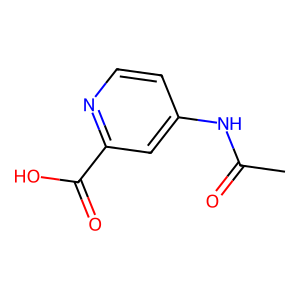 Cas:84487-16-1

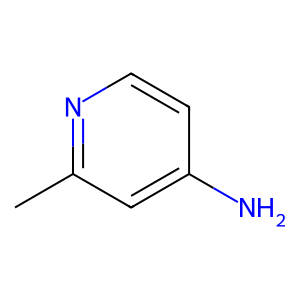 Cas:18437-58-6
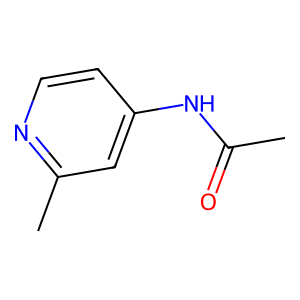 Cas:18085-47-7