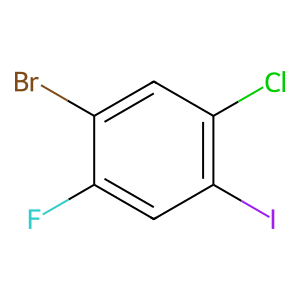
4-Bromo-2-chloro-5-fluoroiodobenzene
CAS No.:
1000572-73-5
M. Wt:
335.34000
M. Fa:
C6H2BrClFI
InChI Key:
AFEZDAWMIXHIIV-UHFFFAOYSA-N
Appearance:
Solid
Names and Identifiers of 4-Bromo-2-chloro-5-fluoroiodobenzene
CAS Number |
1000572-73-5 |
|---|---|
MDL Number |
MFCD09878157 |
IUPAC Name |
1-bromo-5-chloro-2-fluoro-4-iodobenzene |
InChI |
InChI=1S/C6H2BrClFI/c7-3-1-4(8)6(10)2-5(3)9/h1-2H |
InChIKey |
AFEZDAWMIXHIIV-UHFFFAOYSA-N |
Canonical SMILES |
C1=C(C(=CC(=C1I)Cl)Br)F |
UNSPSC Code |
12352100 |
Physical and chemical properties of 4-Bromo-2-chloro-5-fluoroiodobenzene
Exact Mass |
333.80600 |
|---|---|
LogP |
3.84620 |
Melting Point |
34 to 38°C |
Molecular Formula |
C6H2BrClFI |
Molecular Weight |
335.34000 |
Safety Information of 4-Bromo-2-chloro-5-fluoroiodobenzene

Applications of 4-Bromo-2-chloro-5-fluoroiodobenzene
4-Bromo-2-chloro-5-fluoroiodobenzene finds applications in various domains:
- Pharmaceuticals: It serves as an intermediate in the synthesis of biologically active compounds and pharmaceuticals.
- Material Science: The compound can be utilized in the development of new materials, including liquid crystals and polymers that require specific electronic properties.
- Chemical Research: As a versatile building block in organic synthesis, it allows chemists to explore new pathways and reactions involving halogenated compounds.
Interaction Studies of 4-Bromo-2-chloro-5-fluoroiodobenzene
Interaction studies involving 4-bromo-2-chloro-5-fluoroiodobenzene typically focus on its reactivity with nucleophiles or its role in catalysis. For instance:
- Nucleophilic Substitution Studies: Research may explore how different nucleophiles interact with the compound's aromatic system, providing insights into reaction mechanisms and kinetics.
- Catalytic Activity: The compound's potential as a catalyst or catalyst precursor in cross-coupling reactions can also be investigated to understand its efficiency and selectivity.
Biological Activity of 4-Bromo-2-chloro-5-fluoroiodobenzene
The biological activity of 4-bromo-2-chloro-5-fluoroiodobenzene has not been extensively documented in literature, but compounds with similar halogenation patterns often exhibit significant pharmacological properties. For example, halogenated compounds are frequently investigated for their potential as antimicrobial agents, anti-inflammatory drugs, and anticancer therapies due to their ability to interact with biological targets through various mechanisms.
Physical sample testing spectrum (NMR) of 4-Bromo-2-chloro-5-fluoroiodobenzene
