
4-Chlorobenzenesulfinic acid
Names and Identifiers of 4-Chlorobenzenesulfinic acid
CAS Number |
100-03-8 |
|---|---|
EC Number |
202-812-2 |
MDL Number |
MFCD00082741 |
IUPAC Name |
4-chlorobenzenesulfinic acid |
InChI |
InChI=1S/C6H5ClO2S/c7-5-1-3-6(4-2-5)10(8)9/h1-4H,(H,8,9) |
InChIKey |
AOQYAMDZQAEDLO-UHFFFAOYSA-N |
Canonical SMILES |
C1=CC(=CC=C1S(=O)O)Cl |
UNII |
RK78NW65EY |
UNSPSC Code |
12352100 |
Physical and chemical properties of 4-Chlorobenzenesulfinic acid
Acidity coefficient |
1.14±0.10(Predicted) |
|---|---|
Boiling Point |
363.9±44.0 °C at 760 mmHg |
Density |
1.6±0.1 g/cm3 |
Exact Mass |
175.969879 |
Flash Point |
173.9±28.4 °C |
H Bond Acceptors |
2 |
H Bond Donors |
1 |
Index of Refraction |
1.695 |
LogP |
1.09 |
Melting Point |
93 - 95ºC |
Molecular Formula |
C6H5ClO2S |
Molecular Weight |
176.621 |
PSA |
56.51000 |
Vapour Pressure |
0.0±0.9 mmHg at 25°C |
Safety Information of 4-Chlorobenzenesulfinic acid

Applications of 4-Chlorobenzenesulfinic acid
4-Chlorobenzenesulfonic acid has several notable applications:
- Intermediate in Organic Synthesis: It serves as a key building block for synthesizing dyes, pharmaceuticals, and agrochemicals.
- Catalyst in Reactions: It can be used as a catalyst in various organic reactions due to its acidic properties.
- Functionalization Agent: The compound is employed to functionalize surfaces and materials in polymer chemistry and nanotechnology.
Interaction Studies of 4-Chlorobenzenesulfinic acid
Interaction studies involving 4-chlorobenzenesulfonic acid focus on its reactivity with different nucleophiles and electrophiles. These studies help understand its role in various synthetic pathways and biological interactions. For instance, research has highlighted its interactions with amines leading to sulfonamide formation, which has implications for drug development and materials science.
Biological Activity of 4-Chlorobenzenesulfinic acid
Research indicates that 4-chlorobenzenesulfonic acid exhibits some biological activity, particularly as an antibacterial agent. It has been studied for its potential effects on various bacterial strains, although detailed mechanisms of action remain under investigation. Its derivatives have also shown promise in pharmaceutical applications, particularly in developing new antimicrobial agents.
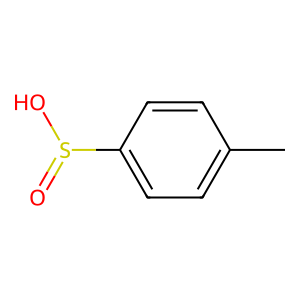 Cas:536-57-2

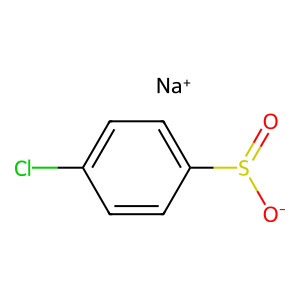 Cas:14752-66-0
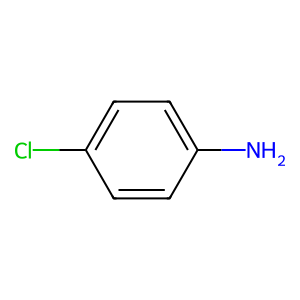 Cas:106-47-8