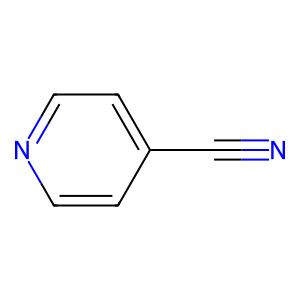
4-Cyanopyridine
Names and Identifiers of 4-Cyanopyridine
CAS Number |
100-48-1 |
|---|---|
EC Number |
202-856-2 |
MDL Number |
MFCD00006417 |
IUPAC Name |
pyridine-4-carbonitrile |
InChI |
InChI=1S/C6H4N2/c7-5-6-1-3-8-4-2-6/h1-4H |
InChIKey |
GPHQHTOMRSGBNZ-UHFFFAOYSA-N |
Canonical SMILES |
C1=CN=CC=C1C#N |
UNII |
BY3226D010 |
UNSPSC Code |
12352100 |
Physical and chemical properties of 4-Cyanopyridine
Acidity coefficient |
pK1:1.90(+1) (25°C) |
|---|---|
Boiling Point |
196.3±13.0 °C at 760 mmHg |
BRN |
107712 |
Density |
1.1±0.1 g/cm3 |
Exact Mass |
104.037445 |
Exposure Limits |
NIOSH: IDLH 25 mg/m3 |
Flash Point |
82.7±5.0 °C |
Index of Refraction |
1.540 |
LogP |
0.41 |
Melting Point |
76-79 °C(lit.) |
Molecular Formula |
C6H4N2 |
Molecular Weight |
104.109 |
PSA |
36.68000 |
Solubility |
40g/l |
Stability |
Stable. Incompatible with strong bases, strong oxidizing agents, strong acids. |
Storage condition |
Sealed in dry,Room Temperature |
Vapour Pressure |
0.31 [mmHg] |
Water Solubility |
3.2 g/100ml (16.4 ºC) |
Solubility of 4-Cyanopyridine
| Solvent Type | Dissolution Behavior | Temperature Effect | pH Effect |
|---|---|---|---|
| Water | Slightly soluble | Solubility slightly increases with temperature | Solubility may increase under alkaline conditions |
| Ethanol | Soluble | Solubility significantly improves with increasing temperature | Minimal effect from pH changes |
| Acetone | Soluble | Solubility increases with temperature | Little impact from pH variations |
| Ethyl acetate | Moderately soluble | Higher temperature aids dissolution | No significant pH effect |
| DMSO | Highly soluble | Strong solvency; minimal temperature influence | pH has insignificant effect on solubility |
| Methanol | Soluble | Solubility enhanced by higher temperature | Minor pH influence |
| Chloroform | Slightly to moderately soluble | Slight improvement in solubility with temperature | No obvious pH effect |
| Strong acid (e.g., HCl) | Partially dissolves or reacts in acidic aqueous solution | Elevated temperature may accelerate reaction or dissolution | Protonation or chemical reaction may occur under acidic conditions |
| Strong base (e.g., NaOH) | Enhanced solubility, may undergo hydrolysis | Increased temperature may promote hydrolysis | Alkaline conditions greatly improve solubility but may lead to decomposition |
Safety Information of 4-Cyanopyridine

Key Milestone of 4-Cyanopyridine
| Time | Event | Description |
|---|---|---|
| End of 19th century – Early 20th century | Early synthesis studies of pyridine derivatives | During the early development of organic chemistry, scientists began systematic research on nitrogen-containing heterocyclic compounds, including pyridine and its substituted derivatives. 4-Cyanopyridine may have been first synthesized as a laboratory product during this period, though it was not explicitly documented or named. |
| 1930s – 1940s | Establishment of systematic synthetic methods for cyanopyridine compounds | With the clarification of electrophilic/nucleophilic substitution mechanisms, chemists developed methods to introduce cyano groups via intermediates such as pyridine N-oxides or halogenated pyridines, enabling controlled preparation of 4-cyanopyridine. |
| 1950s | Initial application as a pharmaceutical intermediate | 4-Cyanopyridine began being used as a key intermediate in synthesizing vitamin B3 (nicotinic acid) analogs and anti-tuberculosis drugs (such as isoniazid derivatives), driving its use in the pharmaceutical industry. |
| 1960s – 1970s | Expansion into agrochemicals and fine chemicals | The compound was employed in synthesizing various pyridine-based herbicides, insecticides (e.g., paraquat analogs), and ligand precursors, emerging prominently in agricultural chemistry and coordination chemistry. |
| 1980s | Use as a ligand precursor in organometallic chemistry | 4-Cyanopyridine was converted into ligands such as 4-pyridylformamidine and 4-aminopyridine, used to construct metal complexes with applications in catalysis and materials science. |
| 1990s – 2000s | Key building block in anticancer and antiviral drug development | Serving as a core intermediate for constructing quinoline, pyrido[2,3-d]pyrimidine, and other heterocycles, it was widely used in developing targeted anticancer drugs, such as kinase inhibitors (e.g., EGFR inhibitors). |
| 2010s – Present | Research on multifunctional materials and green synthesis | Applied in metal-organic frameworks (MOFs), fluorescent probes, and electrochromic materials; meanwhile, more environmentally friendly synthetic routes (e.g., transition-metal-catalyzed cyanation, electrochemical cyanation) have been developed to enhance sustainable production. |
Applications of 4-Cyanopyridine
Interaction Studies of 4-Cyanopyridine
Recent studies have focused on the solubility and molecular interactions of 4-cyanopyridine in aqueous environments. These investigations reveal insights into its behavior in biological systems, influencing its potential applications in drug development and formulation chemistry. Moreover, its interactions with other compounds can lead to enhanced efficacy or stability in pharmaceutical preparations.
Biological Activity of 4-Cyanopyridine
4-Cyanopyridine exhibits various biological activities, making it an important compound in pharmaceutical research. Notably, it serves as an intermediate in the synthesis of isonicotinylhydrazide, which is utilized in treating tuberculosis. Its derivatives have shown potential as anti-cancer agents and exhibit antibacterial properties. Additionally, studies have indicated its role in enhancing the solubility and bioavailability of certain drugs when used as an excipient.
Physical sample testing spectrum (NMR) of 4-Cyanopyridine

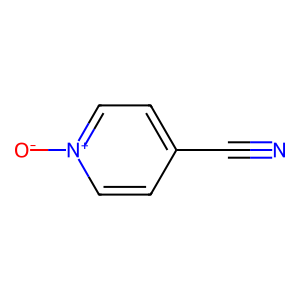 Cas:14906-59-3

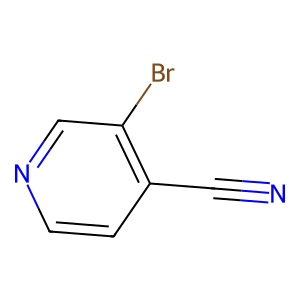 Cas:13958-98-0
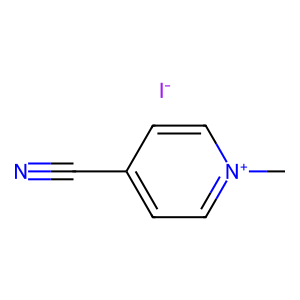 Cas:1194-04-3

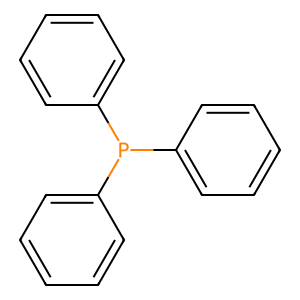 Cas:603-35-0