
4-Ethoxybenzaldehyde
CAS No.:
10031-82-0
M. Wt:
150.174
M. Fa:
C9H10O2
InChI Key:
JRHHJNMASOIRDS-UHFFFAOYSA-N
Appearance:
Colorless to Light yellow to Light orange clear liquid
Names and Identifiers of 4-Ethoxybenzaldehyde
CAS Number |
10031-82-0 |
|---|---|
EC Number |
233-093-3 |
MDL Number |
MFCD00003388 |
IUPAC Name |
4-ethoxybenzaldehyde |
InChI |
InChI=1S/C9H10O2/c1-2-11-9-5-3-8(7-10)4-6-9/h3-7H,2H2,1H3 |
InChIKey |
JRHHJNMASOIRDS-UHFFFAOYSA-N |
Canonical SMILES |
CCOC1=CC=C(C=C1)C=O |
UNII |
GOW1H0F49A |
UNSPSC Code |
12352100 |
Physical and chemical properties of 4-Ethoxybenzaldehyde
Boiling Point |
249.00 to 250.00 °C. @ 760.00 mm Hg |
|---|---|
BRN |
386863 |
Density |
1.078-1.084 |
Exact Mass |
150.068085 |
Flash Point |
112.6±13.4 °C |
Index of Refraction |
1.556-1.564 |
LogP |
2.230 |
Melting Point |
13 - 14 °C |
Molecular Formula |
C9H10O2 |
Molecular Weight |
150.174 |
PSA |
26.30000 |
Sensitivity |
Air Sensitive |
Solubility |
miscible at room temperature (in ethanol) |
Storage condition |
under inert gas (nitrogen or Argon) at 2-8°C |
Vapour Pressure |
0.0±0.5 mmHg at 25°C |
Water Solubility |
Insoluble in water. |
Safety Information of 4-Ethoxybenzaldehyde

Applications of 4-Ethoxybenzaldehyde
4-Ethoxybenzaldehyde finds applications in multiple fields:
- Fragrance Industry: It is widely used as a flavoring agent and fragrance component due to its pleasant scent.
- Pharmaceuticals: The compound serves as an intermediate in synthesizing various pharmaceuticals and agrochemicals.
- Chemical Research: It is utilized in laboratories for research purposes and as a reagent for organic synthesis.
Interaction Studies of 4-Ethoxybenzaldehyde
Studies on the interactions of 4-ethoxybenzaldehyde with biological systems have revealed:
- Metabolism: It has been detected in various foods such as teas, indicating its metabolic pathways and potential health effects when consumed.
- Synergistic Effects: Research suggests that it may interact synergistically with other compounds, enhancing its biological activity or flavor profile when used in formulations.
Several compounds share structural similarities with 4-ethoxybenzaldehyde. Below is a comparison highlighting their uniqueness:
| Compound Name | Molecular Formula | Key Characteristics |
|---|---|---|
| Benzaldehyde | C₇H₆O | Simple aromatic aldehyde without ethoxy group. |
| 4-Methoxybenzaldehyde | C₉H₁₀O₂ | Contains a methoxy group instead of ethoxy. |
| Ethyl Vanillin | C₉H₈O₃ | A flavoring agent with both aldehyde and ether functionalities. |
| p-Hydroxybenzaldehyde | C₇H₆O₂ | Contains a hydroxyl group at the para position. |
Biological Activity of 4-Ethoxybenzaldehyde
Research indicates that 4-ethoxybenzaldehyde possesses biological activities that may include:
- Antimicrobial Properties: Some studies suggest that it exhibits antibacterial activity against certain strains of bacteria.
- Antioxidant Activity: The compound has shown potential antioxidant properties, which may help in combating oxidative stress in biological systems.
- Flavoring Agent: Due to its aromatic profile, it is often included in food products and fragrances, contributing to sensory attributes.
Physical sample testing spectrum (NMR) of 4-Ethoxybenzaldehyde

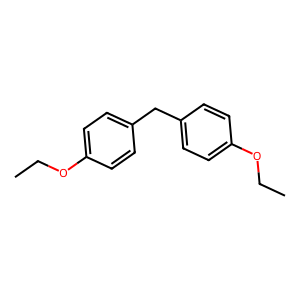 Cas:2212-41-1

 Cas:80077-60-7

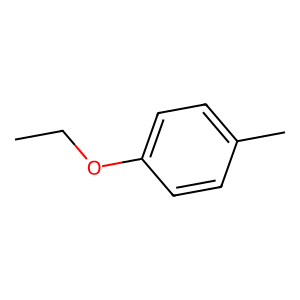 Cas:622-60-6
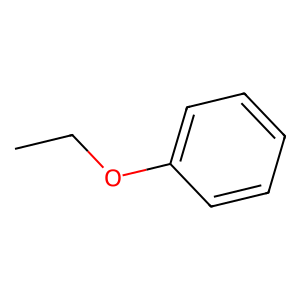 Cas:103-73-1
 Cas:143-33-9