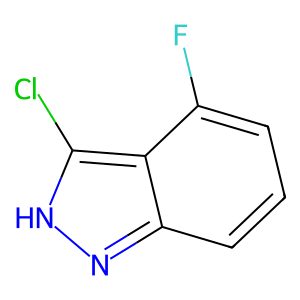
4-FLUORO-3-CHLORO (1H)INDAZOLE
Names and Identifiers of 4-FLUORO-3-CHLORO (1H)INDAZOLE
CAS Number |
1000340-79-3 |
|---|---|
IUPAC Name |
3-chloranyl-4-fluoranyl-2H-indazole |
Canonical SMILES |
C1=CC2=NNC(=C2C(=C1)F)Cl |
Physical and chemical properties of 4-FLUORO-3-CHLORO (1H)INDAZOLE
Boiling Point |
136.7±33.0 °C at 760 mmHg |
|---|---|
Density |
1.5±0.1 g/cm3 |
Exact Mass |
170.004700 |
Flash Point |
36.5±25.4 °C |
Index of Refraction |
1.669 |
LogP |
2.34 |
Molecular Formula |
C7H4ClFN2 |
Molecular Weight |
170.572 |
PSA |
28.68000 |
Vapour Pressure |
7.3±0.3 mmHg at 25°C |
Applications of 4-FLUORO-3-CHLORO (1H)INDAZOLE
3-Chloro-4-fluoro-1H-indazole has several applications across multiple fields:
- Medicinal Chemistry: It is investigated for its potential use in drug development, particularly as inhibitors of specific enzymes or receptors.
- Biological Research: The compound is studied for its diverse biological activities, including antimicrobial and anticancer properties.
- Material Science: It may be utilized in developing new materials with specific properties, such as fluorescence or conductivity.
Interaction Studies of 4-FLUORO-3-CHLORO (1H)INDAZOLE
The interaction studies of 3-Chloro-4-fluoro-1H-indazole focus on its binding affinity to various molecular targets. Research shows that the unique combination of halogen substituents enhances its reactivity and potential biological activity. Mechanistic studies reveal that the compound can form reactive intermediates that interact with cellular components, leading to inhibition or activation of specific pathways.
Biological Activity of 4-FLUORO-3-CHLORO (1H)INDAZOLE
Research indicates that 3-Chloro-4-fluoro-1H-indazole exhibits notable biological activities. It has been studied for its potential antimicrobial and anticancer properties. The presence of halogen substituents enhances its binding affinity to specific molecular targets, which may influence various biological pathways. This compound's mechanism of action often involves interaction with enzymes or receptors, potentially modulating their activity.