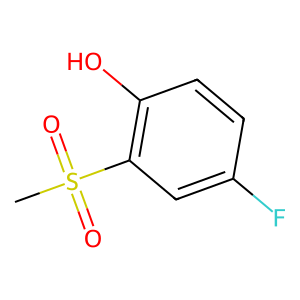
4-Fluoro-2-(methylsulfonyl)phenol
Names and Identifiers of 4-Fluoro-2-(methylsulfonyl)phenol
CAS Number |
1000339-69-4 |
|---|---|
MDL Number |
MFCD09264546 |
IUPAC Name |
4-fluoro-2-methylsulfonylphenol |
InChI |
InChI=1S/C7H7FO3S/c1-12(10,11)7-4-5(8)2-3-6(7)9/h2-4,9H,1H3 |
InChIKey |
KWWNBJSKFLDCBH-UHFFFAOYSA-N |
Canonical SMILES |
CS(=O)(=O)C1=C(C=CC(=C1)F)O |
UNSPSC Code |
12352100 |
Physical and chemical properties of 4-Fluoro-2-(methylsulfonyl)phenol
Boiling Point |
376.9±42.0 °C at 760 mmHg |
|---|---|
Density |
1.4±0.1 g/cm3 |
Exact Mass |
190.009995 |
Flash Point |
181.7±27.9 °C |
Index of Refraction |
1.538 |
LogP |
1.32 |
Melting Point |
122~123℃ |
Molecular Formula |
C7H7FO3S |
Molecular Weight |
190.192 |
Vapour Pressure |
0.0±0.9 mmHg at 25°C |
Safety Information of 4-Fluoro-2-(methylsulfonyl)phenol

Applications of 4-Fluoro-2-(methylsulfonyl)phenol
This compound finds applications across multiple fields:
- Pharmaceutical Industry: Used as an intermediate in the synthesis of active pharmaceutical ingredients.
- Material Science: Serves as a building block for functional polymers and graft polymers.
- Chemical Research: Acts as a reagent in various organic synthesis reactions, particularly those involving carbon-carbon bond formation.
Interaction Studies of 4-Fluoro-2-(methylsulfonyl)phenol
Interaction studies involving 4-Fluoro-2-(methylsulfonyl)phenol have primarily focused on its role in biochemical pathways, especially those related to drug development. The compound has been shown to interact effectively with various biological targets, facilitating the formation of new compounds through reactions like the Suzuki–Miyaura coupling. These interactions are crucial for understanding how this compound can be utilized in developing novel therapeutics.
Biological Activity of 4-Fluoro-2-(methylsulfonyl)phenol
The biological activity of 4-Fluoro-2-(methylsulfonyl)phenol has garnered attention, particularly in pharmacological contexts. It has been identified as a potential building block for active pharmaceutical ingredients due to its selective inhibition properties over receptor tyrosine kinases. This selectivity enhances its utility in medicinal chemistry, particularly for developing compounds that target specific biological pathways. Furthermore, it has been noted for its role in stabilizing hepatocytes in certain quinazolines, indicating potential therapeutic applications.