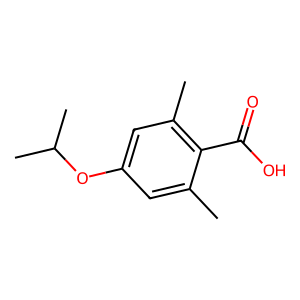
4-Isopropoxy-2,6-dimethylbenzoic acid
Names and Identifiers of 4-Isopropoxy-2,6-dimethylbenzoic acid
CAS Number |
100256-93-7 |
|---|---|
MDL Number |
MFCD11042942 |
IUPAC Name |
2,6-dimethyl-4-propan-2-yloxybenzoic acid |
InChI |
InChI=1S/C12H16O3/c1-7(2)15-10-5-8(3)11(12(13)14)9(4)6-10/h5-7H,1-4H3,(H,13,14) |
InChIKey |
LSSLZIWTSGVMCL-UHFFFAOYSA-N |
Canonical SMILES |
CC1=CC(=CC(=C1C(=O)O)C)OC(C)C |
UNSPSC Code |
12352100 |
Physical and chemical properties of 4-Isopropoxy-2,6-dimethylbenzoic acid
Exact Mass |
208.11000 |
|---|---|
H Bond Acceptors |
3 |
H Bond Donors |
1 |
LogP |
2.78880 |
Molecular Formula |
C12H16O3 |
Molecular Weight |
208.25400 |
PSA |
46.53000 |
Safety Information of 4-Isopropoxy-2,6-dimethylbenzoic acid

Applications of 4-Isopropoxy-2,6-dimethylbenzoic acid
4-Isopropoxy-2,6-dimethylbenzoic acid has several applications across various fields:
- Chemistry: Serves as a building block in organic synthesis and as an intermediate for more complex molecules.
- Biology: Investigated for its potential therapeutic properties.
- Medicine: Explored for anti-inflammatory and antimicrobial effects.
- Industry: Utilized in the production of specialty chemicals and polymers.
Interaction Studies of 4-Isopropoxy-2,6-dimethylbenzoic acid
The interaction studies involving 4-isopropoxy-2,6-dimethylbenzoic acid focus on its ability to engage with specific molecular targets such as enzymes or receptors. These interactions may lead to significant alterations in cellular processes and pathways. For instance, it may inhibit or activate certain enzymes that play crucial roles in metabolic regulation.
Biological Activity of 4-Isopropoxy-2,6-dimethylbenzoic acid
Research indicates that 4-isopropoxy-2,6-dimethylbenzoic acid exhibits potential biological activity. Preliminary studies suggest it may interact with various biomolecules, possibly modulating enzyme activity or receptor interactions. This could lead to effects on metabolic pathways and cellular functions, including potential anti-inflammatory or antimicrobial properties.
Physical sample testing spectrum (NMR) of 4-Isopropoxy-2,6-dimethylbenzoic acid
