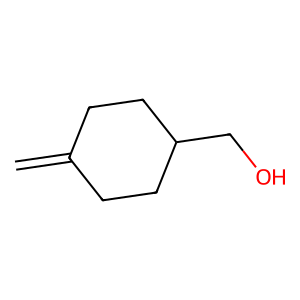
4-Methylenecyclohexylmethanol
Names and Identifiers of 4-Methylenecyclohexylmethanol
CAS Number |
1004-24-6 |
|---|---|
EC Number |
854-172-4 |
MDL Number |
MFCD00045564 |
IUPAC Name |
(4-methylidenecyclohexyl)methanol |
InChI |
InChI=1S/C8H14O/c1-7-2-4-8(6-9)5-3-7/h8-9H,1-6H2 |
InChIKey |
VEDQBZWFMDUFHU-UHFFFAOYSA-N |
Canonical SMILES |
C=C1CCC(CC1)CO |
UNII |
41ZEO89RKY |
UNSPSC Code |
12352100 |
Physical and chemical properties of 4-Methylenecyclohexylmethanol
Acidity coefficient |
14.96±0.10(Predicted) |
|---|---|
Boiling Point |
192.8ºC at 760mmHg |
Density |
0.93g/cm3 |
Exact Mass |
126.10400 |
Flash Point |
79.4ºC |
Index of Refraction |
1.474 |
LogP |
1.72510 |
Molecular Formula |
C8H14O |
Molecular Weight |
126.19600 |
PSA |
20.23000 |
Storage condition |
Sealed in dry,Room Temperature |
Vapour Pressure |
0.127mmHg at 25°C |
Safety Information of 4-Methylenecyclohexylmethanol

Applications of 4-Methylenecyclohexylmethanol
4-Methylenecyclohexylmethanol has several notable applications:
- Frothing Agent: It has been patented for use in froth flotation processes in coal cleaning, where it serves as a less toxic alternative to traditional frothing agents like 2-ethylhexanol.
- Fragrance Industry: Its pleasant odor makes it suitable for use in air fresheners and other fragrance applications.
Interaction Studies of 4-Methylenecyclohexylmethanol
Studies on 4-methylenecyclohexylmethanol have focused on its interactions with biological systems, particularly regarding its metabolic pathways and environmental effects. The compound's metabolites, especially naphthenic acids derived from its oxidation, have been investigated for their acute and chronic toxicity to aquatic life. This highlights the importance of understanding not only the compound itself but also its degradation products.
Biological Activity of 4-Methylenecyclohexylmethanol
Research indicates that 4-methylenecyclohexylmethanol exhibits low acute toxicity. Studies have shown that its lethal dose (LD50) values range from 890 to 5700 mg/kg for rats and exceed 1000 mg/kg for mice, indicating relatively low toxicity compared to other organic compounds. The compound is metabolized primarily to 4-methylcyclohexanecarboxylic acid, which has been studied for its environmental impact due to its presence as a contaminant in water systems.
Physical sample testing spectrum (NMR) of 4-Methylenecyclohexylmethanol

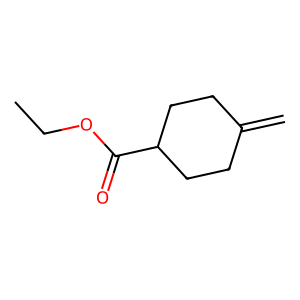 Cas:145576-28-9

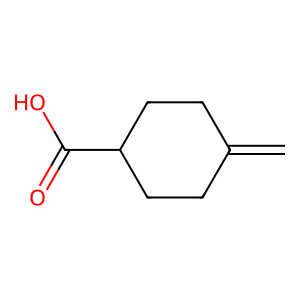 Cas:934-69-0