
4-Methyloxazole-5-carbonitrile
CAS No.:
1003-52-7
M. Wt:
108.09800
M. Fa:
C5H4N2O
InChI Key:
JZSLPQXOLZCAME-UHFFFAOYSA-N
Appearance:
Yellow-brown Liquid
Names and Identifiers of 4-Methyloxazole-5-carbonitrile
CAS Number |
1003-52-7 |
|---|---|
EC Number |
213-709-7 |
MDL Number |
MFCD01111976 |
IUPAC Name |
4-methyl-1,3-oxazole-5-carbonitrile |
InChI |
InChI=1S/C5H4N2O/c1-4-5(2-6)8-3-7-4/h3H,1H3 |
InChIKey |
JZSLPQXOLZCAME-UHFFFAOYSA-N |
Canonical SMILES |
CC1=C(OC=N1)C#N |
UNSPSC Code |
12352100 |
Physical and chemical properties of 4-Methyloxazole-5-carbonitrile
Boiling Point |
200.3ºC at 760mmHg |
|---|---|
Density |
1.18g/cm3 |
Exact Mass |
108.03200 |
Flash Point |
75ºC |
Index of Refraction |
1.488 |
LogP |
0.85468 |
Molecular Formula |
C5H4N2O |
Molecular Weight |
108.09800 |
pH |
8.6 at 19.5℃ and 10g/L |
PSA |
49.82000 |
surface tension |
72mN/m at 1g/L and 20℃ |
Vapour Pressure |
0.326mmHg at 25°C |
Safety Information of 4-Methyloxazole-5-carbonitrile


Applications of 4-Methyloxazole-5-carbonitrile
4-Methyl-1,3-oxazole-5-carbonitrile finds applications in several areas:
- Pharmaceutical Development: Due to its biological activity, it serves as a potential lead compound for drug development.
- Chemical Synthesis: It acts as an intermediate in synthesizing other complex organic molecules.
- Proteomics Research: The compound is utilized in proteomics research for labeling and tracking proteins.
Interaction Studies of 4-Methyloxazole-5-carbonitrile
Research into the interaction of 4-methyl-1,3-oxazole-5-carbonitrile with biological targets is ongoing. Studies focus on:
- Protein Binding Affinity: Understanding how this compound interacts with specific proteins can reveal its potential therapeutic effects.
- Mechanisms of Action: Investigating how it affects cellular pathways could provide insights into its biological efficacy.
These studies are crucial for elucidating the full potential of this compound in medicinal chemistry and drug design.
Biological Activity of 4-Methyloxazole-5-carbonitrile
The biological activity of 4-methyl-1,3-oxazole-5-carbonitrile has been explored in various studies. It exhibits:
- Antimicrobial Properties: Some derivatives show activity against bacteria and fungi.
- Potential Anticancer Activity: Preliminary studies suggest that compounds with oxazole rings may inhibit cancer cell proliferation.
The specific mechanisms of action are still under investigation, but the presence of the oxazole ring is believed to play a significant role in its biological effects.
Physical sample testing spectrum (NMR) of 4-Methyloxazole-5-carbonitrile

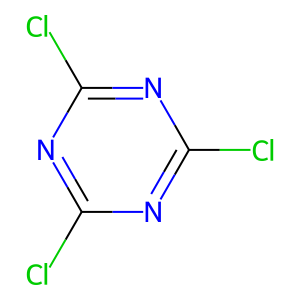 Cas:108-77-0

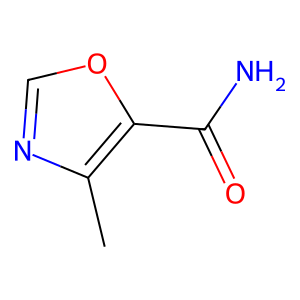 Cas:4866-00-6

 Cas:20485-39-6