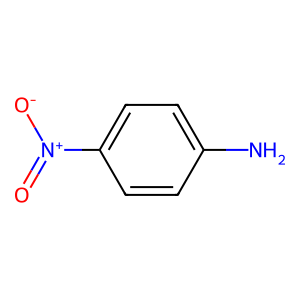
4-Nitroaniline
Names and Identifiers of 4-Nitroaniline
CAS Number |
100-01-6 |
|---|---|
EC Number |
202-810-1 |
MDL Number |
MFCD00007858 |
IUPAC Name |
4-nitroaniline |
InChI |
InChI=1S/C6H6N2O2/c7-5-1-3-6(4-2-5)8(9)10/h1-4H,7H2 |
InChIKey |
TYMLOMAKGOJONV-UHFFFAOYSA-N |
Canonical SMILES |
C1=CC(=CC=C1N)[N+](=O)[O-] |
UNII |
1MRQ0QZG7G |
UNSPSC Code |
12352100 |
Physical and chemical properties of 4-Nitroaniline
Boiling Point |
630 °F |
|---|---|
Decomposition |
When heated to decomp it emits toxic /nitrogen oxides./ |
Density |
1.42 |
Flash Point |
390 °F |
LogP |
2.66 |
Melting Point |
295 °F |
Molecular Formula |
C6H6N2O2 |
Molecular Weight |
138.126 |
Odor |
Slight ammonia-like odor. |
pH |
pH = 6.7 |
Solubility |
0.08% |
Vapour density |
4.77 |
Vapour Pressure |
0.00002 mmHg |
Safety Information of 4-Nitroaniline


Applications of 4-Nitroaniline
The primary applications of 4-nitroaniline include:
- Dye Production: It is a precursor for p-phenylenediamine, which is essential for synthesizing various dyes including Para Red, one of the first azo dyes.
- Pharmaceuticals: It is involved in the synthesis of several pharmaceutical compounds.
- Corrosion Inhibitors: Due to its chemical properties, it is used as a corrosion inhibitor in various industrial applications.
Interaction Studies of 4-Nitroaniline
Research has focused on the catalytic reduction of 4-nitroaniline to p-phenylenediamine using different catalysts. Studies have demonstrated that engineered nanocatalysts can effectively facilitate this reaction under visible light irradiation, showcasing advancements in photocatalytic technologies. These studies highlight the importance of optimizing catalyst composition and reaction conditions for enhanced efficiency.
Biological Activity of 4-Nitroaniline
4-Nitroaniline exhibits toxicity and poses several health risks. It is harmful through inhalation, ingestion, and skin absorption. In laboratory studies, it has shown mutagenic potential and can cause adverse effects on aquatic life, highlighting its environmental hazards. Its LD50 value in rats is reported to be 750 mg/kg when administered orally, indicating significant toxicity.
 Cas:100-25-4

 Cas:110-86-1
 Cas:488-43-7

 Cas:127-09-3
 Cas:64-17-5